



Introduction: choose the application before the machine configuration
A fiber laser marking recommendation should begin with the part and the required mark, not with a power number or a generic material label. The same broad metal category can include different alloys, finishes, coatings, geometries, and inspection requirements. Those details affect the sample-test question and the information an engineering team needs before recommending a configuration.
If you are comparing fiber laser marking machines for a new line, an existing manual station, or a traceability process, prepare the application evidence first. A clear brief helps separate the questions that can be answered from published product information from the questions that require sample testing.
For a broader source-selection framework, see the Fiber, CO2, and UV laser marking machine selection guide.
1. Define the material and surface condition
Start with the exact material rather than only writing “metal.” Record, where available:
- Base material and grade;
- Alloy or material family;
- Coating, plating, anodising, paint, oil, or other surface treatment;
- Surface finish and condition;
- Flat, curved, cylindrical, textured, or irregular surface;
- Material thickness and any nearby heat-sensitive components;
- Whether the same marking must work across multiple material variants.
The goal is not to assume that every metal behaves the same way. The goal is to give the engineering team enough information to design a meaningful sample test and identify the relevant machine questions.
2. Specify what the mark must achieve
A marking request should describe the required result in observable terms. Include:
- Text, serial number, barcode, QR code, logo, graphic, or a combination;
- Mark location and usable marking area;
- Required contrast or appearance;
- Whether the result is a surface mark, colour change, or engraving requirement;
- Readability conditions and inspection method;
- Whether the mark must remain readable after a defined downstream process;
- File format, variable-data source, or production-system input if relevant.
Avoid replacing the required outcome with a vague term such as “high quality.” Define how the team will decide whether the mark passes or fails.
3. Check part geometry, fixtures, and handling
Part geometry often determines the practical application setup. Document:
- Part dimensions and weight;
- Flat, cylindrical, curved, recessed, or irregular surfaces;
- Loading and unloading method;
- Fixture requirements and repeatability needs;
- Rotary-axis requirement for cylindrical parts;
- Available working space and operator access;
- Whether the part is marked one at a time or in a batch;
- Whether orientation is fixed, scanned, or supplied by a handling system.
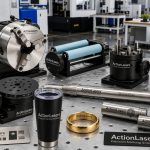
A rotary attachment can address a cylindrical handling requirement, but its suitability still depends on the part geometry, fixture method, marking position, and operating workflow. Do not describe a component image as proof of a complete automated line.
4. Map the production workflow before discussing integration
The same marking task can require different equipment decisions depending on how data and parts move through production. Describe:
- Where the part enters the process;
- How the part is identified and positioned;
- Where marking data comes from;
- How the marking command is triggered;
- How the part leaves the station;
- How the mark is inspected and recorded;
- What happens when a part or mark fails inspection.
If integration is part of the request, include the existing line layout, signal or data requirements, safety constraints, and the desired operator workflow. Review industrial laser automation solutions as a relevant product-category reference, then confirm the exact scope with the engineering team.
5. Use sample testing as the selection gate
A sample test should answer a specific decision question, such as whether the proposed mark meets the required contrast, readability, appearance, or surface-impact criteria on the actual material.
Agree on the following before testing:
- Sample material and surface condition;
- Candidate marking approach to evaluate;
- Mark artwork, text, code, or variable-data example;
- Mark size and location;
- Inspection method and viewing conditions;
- Pass/fail criteria;
- Acceptable surrounding-surface change;
- Repeatability requirement across multiple parts;
- Information to include in the test report.
A sample result is evidence for the tested material, configuration, and acceptance criteria. It should not be rewritten as a universal production guarantee.
For general support and application questions, use the laser machine support page.
6. Questions to ask when comparing fiber laser options
Use a comparison checklist that connects each machine question to a production requirement:
| Decision area | Evidence to prepare | Question for the supplier or engineering team |
|---|---|---|
| Material | Grade, finish, coating, surface condition | Has the exact material and surface condition been tested? |
| Mark result | Artwork, contrast, readability, depth or surface effect | What acceptance method will determine a passing mark? |
| Part geometry | Dimensions, curvature, fixture and rotary needs | How will the part be positioned and held? |
| Data workflow | Static or variable content, source system, trigger | How will marking data enter the process? |
| Production | Manual, fixture-based, conveyor, or line integration | What handling and operator steps are required? |
| Inspection | Camera, operator, gauge, or downstream check | How will failed marks be identified and recorded? |
| Safety and environment | Enclosure, extraction, workplace constraints | What site requirements must be confirmed before installation? |
| Commercial review | Scope, documentation, support needs | What information is included in the recommendation and quotation? |
This table is a request-preparation framework, not a product specification sheet.
7. Prepare a complete application review request
Send the following information when requesting a machine recommendation:
- Material name, grade, coating, and surface condition;
- Part photos, dimensions, and drawings;
- Mark artwork, text, barcode, QR code, or sample data;
- Required mark size, position, contrast, and readability standard;
- Current production method and the problem to solve;
- Target workflow and expected operator steps;
- Fixture, rotary, conveyor, or automation requirements;
- Sample-part availability and delivery region;
- Inspection method and acceptance criteria;
- Contact details for technical follow-up.
Do not send confidential drawings or customer information unless your internal approval process permits it. Remove unnecessary sensitive data from the first request.
When to review other laser sources
Fiber is not the only possible source for every marking or cutting requirement. If the application involves a non-metal material, coated substrate, or a different surface response, compare the actual requirement against other source options rather than selecting by name alone.
The existing CO2 vs. fiber industrial marking guide provides a related comparison route. The laser applications hub can be used to review confirmed application categories before submitting a material for testing.
Request a fiber laser application review
The most useful next step is an application review based on the actual material, part geometry, marking content, production workflow, and acceptance criteria.
Suggested CTA copy:
Share your material details, part photos or drawings, marking content, workflow, and acceptance criteria. ActionLasers can review the application requirements and identify the information needed for a suitable fiber laser marking recommendation.
- Primary CTA: Request an application review
- Secondary CTA: Review fiber laser machine options
- Support route: Review laser machine support
FAQ
Is a fiber laser always the right choice for metal marking?
Not automatically. The material grade, surface condition, required mark, part geometry, workflow, and acceptance criteria should be reviewed and, when necessary, tested on representative samples.
What information should I provide for a fiber laser marking review?
Provide the material and surface condition, part dimensions and photos, marking artwork or data, required mark size and appearance, production workflow, fixture or automation requirements, inspection method, and acceptance criteria.
Do I need sample parts before requesting a recommendation?
Sample parts are valuable when the required mark appearance, readability, surface response, or workflow fit cannot be confirmed from documentation alone. They allow the test to use the actual material and acceptance method.
Can a fiber marking application include cylindrical parts?
It may, depending on the part geometry, fixture method, marking position, and rotary-handling requirements. Include accurate part dimensions and a drawing so the setup can be assessed.
How should I compare fiber laser machine options?
Compare them against the application: material evidence, mark requirements, part handling, data workflow, inspection, support, and the sample-test result. Do not compare power or machine names in isolation.