

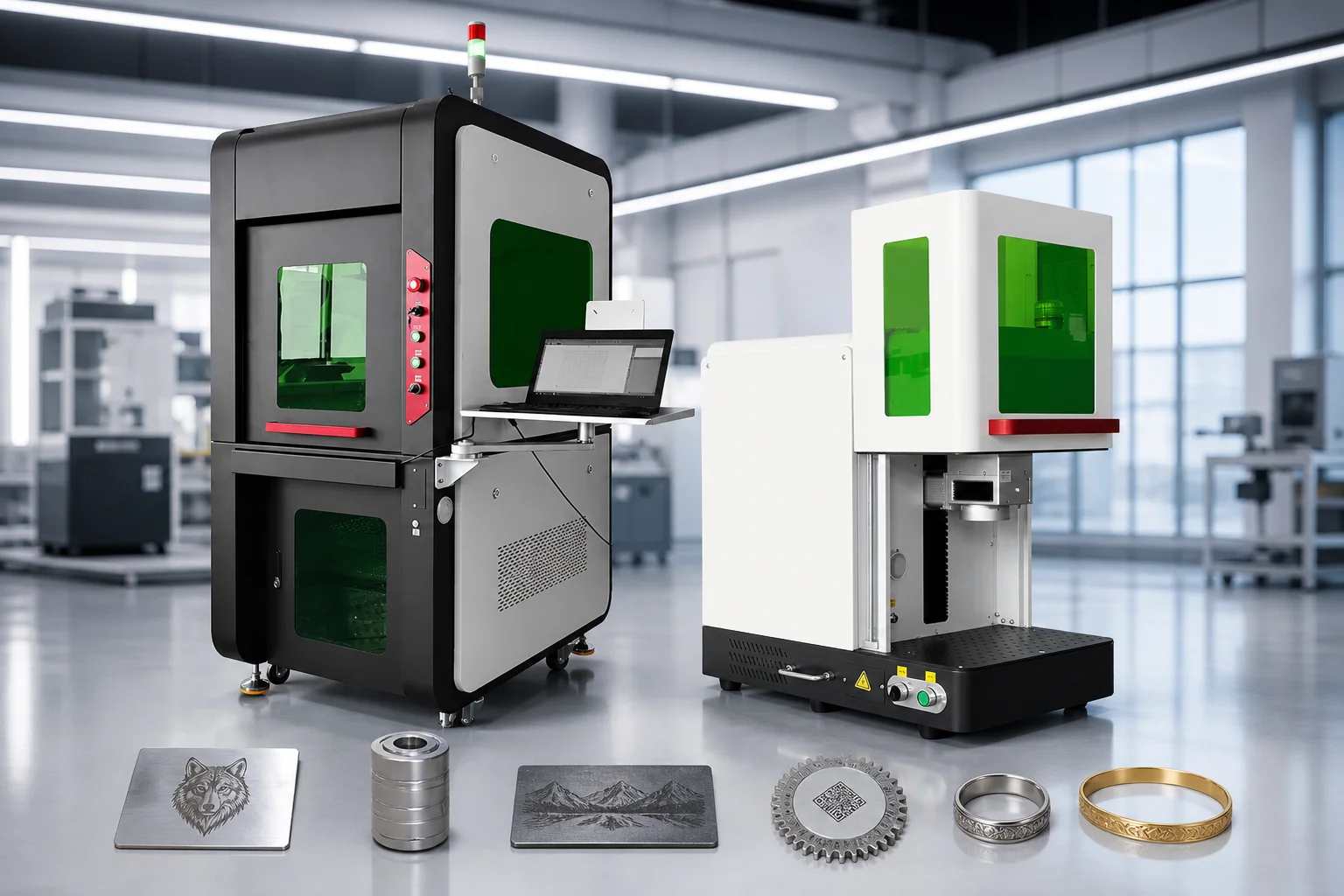
In modern Western industrial facilities, medical labs, and boutique jewelry studios, workplace safety regulations (OSHA 29 CFR 1910.133 and EU CE EN 60825-1) have made open-beam Class 4 lasers a major compliance hurdle. The ActionLasers™ Fully Enclosed (Class 1) Laser Marking Series delivers zero-compromise operator safety, certified OD6+ optical shielding, and industrial beam precision—eliminating the need for protective goggles and isolated laser rooms.
1. Executive Overview: The Regulatory Imperative for Enclosed Laser Systems
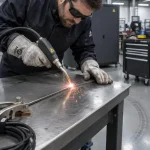
An open-beam fiber or UV laser is classified as a Class 4 laser system, carrying severe risks of permanent retinal damage and skin burns from specular and diffuse reflections. Operating a Class 4 open-bed system mandates designated light-tight laser controlled areas (LCAs), mandatory protective eyewear for all personnel, and designated Laser Safety Officers (LSO).
By encasing the high-energy laser beam inside a certified protective enclosure equipped with OD6+ laser-shielding viewing glass and fail-safe magnetic interlock doors, our workstations convert high-power 20W–100W laser sources into 100% safe, unrestricted Class 1 environments. Operators can safely observe real-time marking without wearing protective goggles.
2. Core Safety Engineering & Design Architecture
- Certified OD6+ Laser Shielding Windows: German-certified optical acrylic/polycarbonate composite glass rated at Optical Density OD6+ (attenuation factor > 1,000,000×) blocks hazardous 1064nm (Fiber/MOPA) and 355nm (UV) reflections while maintaining high visible light clarity.
- Dual-Channel Safety Interlock Mechanisms: Category-4 safety interlock switches terminate laser emissions within 10 milliseconds if the door is opened during operation.
- Integrated Fume & Particulate Extraction Port: Rear aerodynamic exhaust flange connects directly to industrial HEPA and activated carbon filtration units, capturing dust, metallic fumes, and odors.
3. Form Factor Comparison: Desktop Enclosed vs. Industrial Floorstanding
| Technical Parameter | Compact Desktop Enclosed Model | Heavy-Duty Floorstanding Workstation |
|---|---|---|
| Laser Source Options | 20W / 30W / 50W Fiber or MOPA | 30W / 50W / 60W / 100W Fiber, MOPA, or UV |
| Laser Wavelength | 1064 nm / 355 nm | 1064 nm / 355 nm / 532 nm |
| Safety Classification | Class 1 (Fully Enclosed) | Class 1 (Fully Enclosed) |
| Door Mechanism | Counterbalanced Lift Mask with Safety Interlock | Motorized Electric/Pneumatic Vertical Slide Door |
| Marking Field Size | 70×70 mm / 110×110 mm / 150×150 mm | 110×110 mm up to 300×300 mm |
| Max Marking Speed | 7,000 mm/s | Up to 12,000 mm/s |
| Machine Dimensions (L×W×H) | 670 × 430 × 680 mm | 1180 × 780 × 1740 mm |
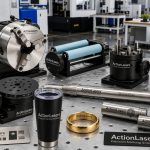
| Rotary Axis Compatibility | Compact Jewelry Rotary Chuck (Rings/Bangles) | Heavy-Duty 3-Jaw / 4-Jaw Chuck & Roller Rotary |
| Ideal Applications | Retail Jewelry Stores, Medical Labs, Toolrooms | Industrial Production Lines, Aerospace, Defense |
4. Multi-Material Processing Capabilities & Applications
4.1 Custom Jewelry & Precious Metals
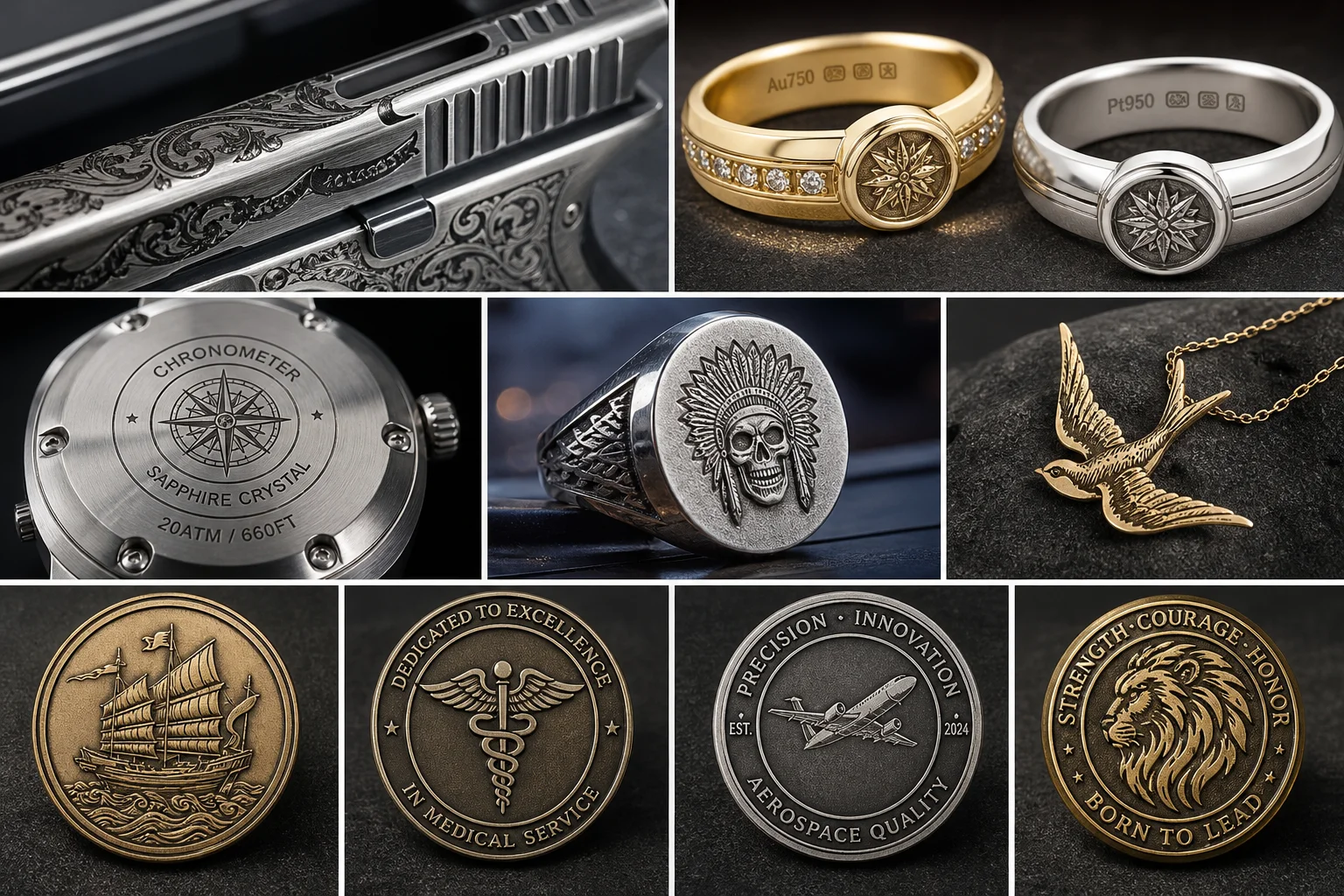
- Ring Inside/Outside Engraving: Synchronized rotary fixtures mark high-resolution hallmarks (Au750, Pt950), serials, and custom names.
- Micro-Cutting of Gold & Silver Sheets: Precision piercing and filigree cutout designs for pendants and bespoke nameplates.
4.2 Firearms, Defense & Tactical Gear
- ATF-Compliant Deep Serial Engraving: Reaching 0.003-inch depth serial numbers on steel and titanium gun slides, lower receivers, and magazines.
- Decorative Relief & Stippling: High-contrast scrollwork and non-slip grip textures on polymer and aluminum frames.
4.3 Medical Device & Surgical Instrument UDI
Permanent, non-tactile black corrosion-resistant markings on stainless steel 316L and titanium without disturbing surface passivity or passivation layers.
5. Frequently Asked Questions (FAQ)
Q1: Why do European and North American buyers specifically demand Class 1 enclosed laser machines?
A: Under EU CE regulations (EN 60825-1) and US OSHA rules, open Class 4 lasers require isolated optical rooms, interlocked door systems, and mandatory safety goggles. A Class 1 fully enclosed machine eliminates these regulatory burdens, allowing safe placement directly on open factory floors, retail counters, or research labs.
Q2: Can I observe the laser marking process through the green window without safety goggles?
A: Yes. The viewing window is constructed from certified OD6+ optical filter acrylic, which attenuates over 99.9999% of 1064nm and 355nm laser reflections while maintaining clear visible light transmission (VLT) for effortless process monitoring.
Q3: What happens if an operator opens the door while the laser is running?
A: ActionLasers™ enclosed units feature dual-channel safety interlock sensors. Opening the door instantly interrupts the laser power circuit within 10 milliseconds, shutting down beam emission before human eyes or skin can be exposed.
Q4: Does the enclosed machine include fume extraction?
A: All enclosed models feature a standardized rear exhaust flange designed for quick connection to external HEPA and activated carbon filtration units, capturing dust, metallic fumes, and odors.