

Introduction
If your production line involves marking wood, paper, glass, plastics, leather, or packaging materials, a CO2 laser marking machine is likely your most efficient solution. Unlike inkjet printers that need constant consumable refills or fiber lasers that struggle with non-metal substrates, a CO2 laser marker produces permanent, high-contrast marks without touching the material — and without inks, solvents, or moving printheads to wear out.
But with power ratings from 30 W to over 100 W, tube technologies that vary 10× in lifespan, and price tags that range from a few thousand to tens of thousands of dollars, choosing the right laser marking machine can feel overwhelming. This guide walks through every decision factor — from material compatibility to total cost of ownership — so you can match your industrial laser marking machine to your actual production needs, not just the lowest upfront price.
What Is a CO2 Laser Marking Machine?
A CO2 laser marking machine uses a gas mixture — primarily carbon dioxide, nitrogen, and helium — excited by an electrical discharge to produce a laser beam at a wavelength of 10.6 µm (far infrared). This wavelength is strongly absorbed by organic and many polymeric materials, making it ideal for marking non-metal surfaces.
The beam is directed by a galvanometer (galvo) scanner system that moves two tiny mirrors to steer the laser across the workpiece at high speed. Unlike gantry-based laser cutters, galvo-based CO2 laser marking machines achieve marking speeds of up to 8,000–12,000 mm/s, which is essential for high-volume production lines such as food packaging coding or pharmaceutical serialization. Many modern laser marking systems also incorporate vision alignment for automated production.
The marking mechanism itself is thermal: the laser energy either ablates (vaporizes) a thin surface layer, carbonizes organic material to create a dark mark, or foams certain plastics to produce a raised white mark. Each effect is permanent, smudge-proof, and resistant to cleaning chemicals or abrasion.
Key Factors When Choosing a CO2 Laser Marking Machine
Power Output — Matching Wattage to Your Materials
CO2 laser marking machines typically come in power ratings of 30 W, 40 W, 60 W, and 100 W. Here is what each range is best suited for:
| Power Range | Best For | Typical Applications |
|---|---|---|
| 30 W | Thin plastics, paper, cardboard, light wood | Batch coding, small gift engraving, DIY production |
| 40 W | Wood, leather, acrylic, glass, packaging films | Packaging date/lot codes, branding on consumer goods, medium-throughput production |
| 60 W | Thicker acrylic, dense hardwoods, coated metals | Signage, industrial part marking, higher-speed production lines |
| 100 W | Deep engraving on wood/acrylic, thick materials | Industrial-scale cutting-engraving, heavy-duty continuous operation |
A 40 W CO2 laser marking machine is the most common entry point for small to medium businesses. It handles the vast majority of packaging substrates and organic materials without the higher upfront cost of a 60 W or 100 W unit. If you primarily mark thin plastic films or paper-based packaging, a 30 W laser marking machine is sufficient. For deeper engraving into hardwoods or thicker acrylics, step up to 60 W or above.
Material Compatibility — What a CO2 Laser Can and Cannot Mark
The CO2 laser’s 10.6 µm wavelength is exceptionally well absorbed by organic and non-metal materials. This makes it the ideal industrial laser marking machine for the following substrates:
- Wood and wood products — carbonization creates dark, permanent marks with excellent contrast
- Paper and cardboard — fast, high-contrast coding on packaging
- Glass and ceramics — frosted etching effect without cracking when parameters are tuned correctly
- Leather and textiles — clean engraving with minimal edge charring
- Acrylic (PMMA) — produces a polished, flame-polished edge appearance when cutting
- Plastics — most common packaging plastics (PET, PVC, PP, PE, ABS) mark well with CO2; some clear plastics require a marking additive or specific parameter tuning
- Rubber and elastomers — ideal for industrial stamps, gaskets, and date codes
Limitations: CO2 lasers cannot directly mark bare metals because the 10.6 µm wavelength reflects off metallic surfaces. Marking metal requires a special absorbing coating or paste. For direct metal marking, a fiber laser system or UV laser is the better choice. Similarly, transparent plastics that do not absorb 10.6 µm (e.g., some polyolefins) may require a UV laser marker for cold marking without thermal damage.
When in doubt, reputable laser marker suppliers offer sample testing — send them your actual material and they will produce a marked sample to confirm quality before committing to a CO2 laser marking machine.
Marking Area and Precision
The marking area is defined by the galvo head’s lens and how high it is mounted. Common field sizes for CO2 laser marking systems range from 110×110 mm (standard) to 300×300 mm (wide-field). A larger marking area reduces the need to reposition parts but requires higher laser power to maintain energy density per unit area.
For most packaging and product marking tasks, a 110×110 mm or 150×150 mm field is sufficient. Applications requiring serial number or data matrix code marking on large parts benefit from a 200×200 mm or larger field. Precision is typically ±0.01 mm positioning accuracy, which is adequate for barcodes, QR codes, logos, and fine text down to 1-point size.
Laser Tube Type — RF Metal Tube vs. Glass (DC) Tube
This is one of the most consequential decisions when choosing a laser marking machine. The tube type directly affects lifespan, beam quality, and long-term operating cost.
| Feature | RF Metal/Ceramic Tube | Glass (DC) Tube |
|---|---|---|
| Typical lifespan | 20,000 – 50,000 hours | 1,500 – 3,000 hours |
| Beam quality (M²) | <1.2 (stable) | 1.5 – 2.0 (degrades over time) |
| Power modulation | Fast response, precise pulse control | Slower, less consistent |
| Cooling | Air-cooled or light water cooling | Water cooling required |
| Upfront cost | Higher | Lower |
| Best use | Production / 24/7 industrial use | Low-volume / workshop / hobby |
RF (radio-frequency) metal tubes offer dramatically longer life and more consistent beam quality. For any business running a CO2 laser marking machine 8+ hours a day, the higher initial investment pays for itself within the first 1–2 years due to eliminated tube replacements and downtime. Glass DC tubes are more affordable upfront but require replacement every few months under heavy use, and their beam quality degrades noticeably toward the end of life.
Data source: RP Photonics Encyclopedia of Laser Physics and Technology — CO2 Lasers article
Cooling System
CO2 lasers generate significant heat. Smaller units (30–40 W) in a compact industrial laser marking machine may use air cooling, while higher-power tubes (60 W and above) and most glass tubes require water cooling with a chiller or radiator system. A properly sized cooling system ensures stable power output and tube longevity. If your facility lacks water lines, an RF-based air-cooled system simplifies installation considerably.
Software and Control Integration
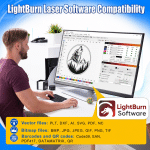
Modern CO2 laser markers support industry-standard software such as EzCad, LightBurn, RDWorks, and LaserGRBL. For production-line integration, look for laser marking systems that support:
- Vision alignment — camera-based positioning for pre-printed packaging
- Rotary axis — for cylindrical parts like bottles, tubes, or cups
- Automation I/O — conveyor triggers, PLC integration, barcode scanner handshake
- Database connectivity — import variable data (batch numbers, expiry dates, serial numbers) from CSV or ERP systems
Total Cost of Ownership (TCO)
Beyond the purchase price of your CO2 laser marking machine, factor in:
- Tube replacement — a glass tube at $200–$500 replaced every 2,000 hours vs. an RF tube at $2,000–$4,000 replaced every 30,000+ hours
- Cooling maintenance — water quality, chiller filters, antifreeze
- Galvo mirror cleaning and replacement — every 1–2 years for production machines
- Software licensing — some brands charge for upgrades or multi-seat licenses
A lower-priced machine often costs more in its first three years of operation when tube replacements and downtime are factored in. Run a TCO projection before committing to any laser marking machine.
CO2 Laser vs. Fiber vs. UV — When Each Makes Sense
| Criteria | CO2 Laser | Fiber Laser | UV Laser |
|---|---|---|---|
| Wavelength | 10.6 µm (far IR) | 1.06 µm (near IR) | 355 nm (UV) |
| Best materials | Wood, paper, glass, plastics, leather, acrylic | Metals, some plastics | Delicate plastics, glass, semiconductors |
| Metal marking | Only with coating paste | Excellent (direct) | Good |
| Mark speed | High (galvo) | Very high (galvo) | Moderate |
| Wall-plug efficiency | ~10–20% | ~25–40% | ~5–10% |
| Typical tube life | 1,500–50,000 h (varies by type) | 50,000–100,000 h | 10,000–20,000 h |
When a CO2 laser is the right choice: You primarily mark non-metal materials such as paperboard packaging, wood products, plastic containers, glass bottles, or leather goods. The mark quality on organics is superior to fiber — a CO2 laser marker produces deeper contrast on wood and more consistent frosted etching on glass.
When it is not: Your production is mostly bare metal parts (stainless steel, aluminum, brass) — a fiber laser marking system is the correct tool. Or you need to mark heat-sensitive materials with zero thermal damage — UV laser is the better fit.
Many medium-to-large facilities run both a CO2 laser marker and a fiber laser marker to cover their full material range. If you only have budget for one industrial laser marking machine, pick the one that matches 80% of your current materials and outsource the rest.
Industry Applications for CO2 Laser Marking Systems
CO2 laser marking systems are deployed across a broad range of industries:
- Food and beverage packaging — date codes, batch numbers, and expiration dates printed directly onto cardboard cartons, plastic films, and glass bottles. An industrial laser marking machine with CO2 source eliminates ink contamination risk and meets FDA traceability standards for food contact surfaces.
- Pharmaceutical packaging — serialization codes and tamper-evident markings on blister packs, pharma-grade plastics, and folding cartons. CO2 lasers produce permanent, solvent-resistant marks that survive sterilization.
- Cosmetics and personal care — brand logos, ingredient codes, and batch information on plastic bottles, glass jars, and paperboard boxes.
- Woodworking and furniture — decorative engraving, serial numbers, and brand marks on solid wood, plywood, MDF, and bamboo.
- Textile and apparel — fabric engraving, denim fading, and leather embossing for fashion accessories and footwear.
- Electronics — marking plastic housings, connectors, and cable insulation with permanent identification using a compact CO2 laser marking machine.
Maintenance and Service Life Expectations
A well-maintained CO2 laser marking machine can operate reliably for 5–10 years. Key maintenance routines include:
- Weekly: Clean the galvo mirrors and focusing lens with isopropyl alcohol and lint-free wipes. Check cooling water level and temperature.
- Monthly: Inspect the laser tube for signs of degradation (reduced power, unstable output). Clean exhaust fans and air filters.
- Quarterly: Replace chiller water and check coolant additive concentration. Verify beam alignment and recalibrate if necessary.
- Annually: Replace wear components such as lenses, galvo mirrors (if pitted), and cooling system filters. Have the power supply and control board inspected by a technician.
With an RF metal tube rated for 30,000+ hours, a machine running one 8-hour shift per day will need its first tube replacement only after 10+ years. Glass-tube machines will need a new tube every 6–18 months depending on usage.
Conclusion
Choosing the right CO2 laser marking machine starts with a clear understanding of your materials, production volume, and budget. Match your power to your hardest-to-mark material, invest in an RF tube if you run production shifts, and always test samples before buying.
If you are looking for industrial laser marking equipment that balances quality with cost-effectiveness, explore our range of CO2 laser marking machines. We offer configurations from 30 W to 100 W with both glass and RF tube options, plus free sample testing so you can verify results on your own materials before committing. Whether you need a basic laser marker for small-batch work or a full production laser marking system, our team can help you choose the right machine for your application. Contact us for a tailored solution proposal.