

1. Introduction: When to Choose CO2 Laser Technology
CO2 laser marking machines operate at a 10.6μm (or optional 9.3μm / 10.2μm) wavelength in the infrared spectrum, which is naturally and efficiently absorbed by organic materials and non-metal substrates.
Unlike fiber lasers that excel in direct metal processing, CO2 lasers are the premier industrial solution for:
- Packaging coding: Date codes, lot numbers, 2D DataMatrix on cardboard and coated foils
- Organic materials: Timber, plywood, leather, paper, rubber
- Transparent and semi-transparent synthetics: Acrylic (PMMA), PET, glass engraving
For a broader source-selection framework across laser types, see our Fiber, CO2, and UV laser marking machine selection guide.
2. Material Feasibility & Interaction Matrix
The 10.6μm wavelength interacts with various non-metallic substrates through distinct thermal and optical mechanisms:
| Substrate Material | Laser Absorption Mechanism | Typical Mark Finish | Recommended Power Tier |
|---|---|---|---|
| Corrugated Paper / Cardboard | High (Thermal vaporization) | Crisp dark brown / black contrast | 30W – 40W |
| PET / Plastic Containers | Controlled surface foaming | White / frosted legible mark | 30W (Flying system) |
| Acrylic (PMMA) | Clean edge melting / vaporization | High-transparency or frosted etch | 40W – 60W |
| Wood / Bamboo | Deep thermal charring | Dark embossed natural contrast | 40W – 60W |
| Glass / Ceramics | Micro-cracking / Surface fracture | Frosted permanent vector mark | 30W – 40W (Fine lens) |
| Leather / Textiles | Surface layer stripping | Texture alteration / Dark mark | 30W – 60W |
3. Power Selection Guidelines (30W vs. 40W vs. 60W)
Choosing the correct RF metal tube power rating depends directly on the substrate density and the required line cycle speed:
- 30W CO2 Laser: Optimized for static marking stations, barcode printing on consumer packaging, and medium-speed bottle date coding where shallow ablation and clean surface marks are required.
- 40W CO2 Laser: The standard workhorse for high-speed automated packaging lines, continuous carton coding, and fast synthetic film marking.
- 60W CO2 Laser: Engineered for deep engraving on hardwood, thick acrylic cutting/marking, high-line-speed industrial automation, and heavy-duty serialisation.
4. Static vs. Flying Marking (On-the-Fly Integration)
For high-throughput manufacturing facilities integrating laser systems into continuous conveyor packaging lines:
- Encoder Synchronization: Optical rotary encoders track conveyor speed in real time, ensuring distortion-free 1D/2D barcodes regardless of line acceleration or deceleration.
- Photoelectric Triggering: High-response optical sensors trigger the galvanometer scanner in microsecond intervals as parts pass the marking window.
- Fume Extraction: Class 1 protective enclosures and high-efficiency HEPA + activated carbon fume extractors capture thermal vapor and particulates at the point of origin.
Explore our integrated industrial laser automation solutions for conveyor retrofits.
5. Frequently Asked Questions (FAQ)
Q1: Can a CO2 laser mark on bare stainless steel or aluminum?
A: Bare metals do not efficiently absorb the 10.6μm CO2 wavelength. To mark bare metals directly, a fiber laser marking machine (1064nm) is recommended, or a specialized thermal marking spray must be applied prior to CO2 processing.
Q2: What is the lifespan of an RF metal laser tube vs. a glass tube?
A: Industrial RF (Radio Frequency) all-metal laser tubes offer 20,000 to 45,000 hours of operating life and can be re-gassed, whereas standard glass tubes offer 3,000 to 8,000 hours before requiring replacement.
Q3: What marking window sizes are available for CO2 lasers?
A: Standard configurations utilize F-theta lenses supporting 110×110mm, 150×150mm, 200×200mm, or 300×300mm marking fields depending on the required spot resolution.
Q4: Does CO2 laser marking generate hazardous fumes?
A: Yes. Marking plastics, acrylics, and treated woods releases fumes and microscopic dust. A dedicated multi-stage fume extraction unit is essential for operator safety and lens protection.
Q5: What software and vector file formats are supported?
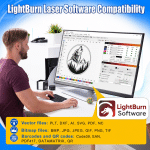
A: ActionLasers CO2 marking controllers support standard vector and bitmap formats including DXF, PLT, AI, BMP, JPG, and dynamic QR / Barcode generation via EZCAD-compatible industrial software.
6. Pre-Purchase Sample Testing & Consultation
Before finalizing your machine power and optical configuration, we recommend sending your actual packaging or non-metal material samples to our testing center:
- Marking cycle time verification per part
- Visual contrast and character sharpness measurement
- Lens focal length determination for non-planar geometries