



Choosing a handheld laser welding machine is an engineering decision, not simply a wattage purchase. The right system must balance penetration, travel speed, metallurgy, joint fit-up, operator ergonomics, consumables, cooling, extraction and laser safety. This guide covers practical selection of 1000W, 1500W, 2000W and 3000W fiber laser welders.
Contents
- How handheld fiber laser welding works
- 1000W–3000W engineering comparison
- Power and thickness quick-reference
- Wobble gun, nozzle and wire-feeding setup
- Laser welding vs TIG
- Safety, compliance and commissioning
- Frequently asked questions
1. How a handheld fiber laser welding machine works
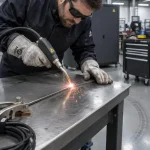
A modern handheld system couples a continuous-wave fiber laser source to a scanning welding head. The head oscillates the focused spot across the joint, widening the effective bead and improving tolerance to small gaps. Shielding gas protects the molten pool from oxidation and water cooling removes heat from the source and head. Laser welding concentrates energy into a small heat-affected zone (HAZ), often reducing distortion and post-weld grinding. Published thickness values are starting points, not guarantees.
2. 1000W–3000W engineering comparison
| Engineering parameter | 1000W | 1500W | 2000W | 3000W |
|---|---|---|---|---|
| Best fit | Thin sheet, repair, light fabrication | General fabrication and stainless work | Production work and thicker carbon steel | High-throughput, thick section and demanding joints |
| Typical clean fusion range* | 0.5–2.0 mm | 0.8–3.0 mm | 1.0–4.0 mm | 1.5–6.0 mm |
| Primary advantage | Lower power draw and entry cost | Balanced flexibility | Higher speed and penetration margin | Maximum deposition and throughput |
| Cooling | Closed-loop chiller | Closed-loop chiller | Higher-capacity chiller | Industrial chiller and thermal monitoring |
*Indicative butt-joint ranges for common mild steel or stainless steel with suitable fit-up, optics, shielding gas and qualified parameters. Validate with representative coupons.
How to choose the power rating
- 1000W: Thin stainless, mild steel, small repair work and low-to-medium duty cycles.
- 1500W: Practical all-rounder for sheet-metal shops seeking balanced speed and penetration.
- 2000W: Production takt time, thicker sections and variable fit-up with additional process margin.
- 3000W: Maximum throughput and deep fusion; verify facility power, cooling, extraction, guarding and training.
3. Power and thickness quick-reference table
| Material / joint | 1000W | 1500W | 2000W | 3000W |
|---|---|---|---|---|
| Stainless steel butt joint | 0.5–1.5 mm | 0.8–2.5 mm | 1.0–3.5 mm | 1.5–5.0 mm |
| Mild/carbon steel butt joint | 0.8–2.0 mm | 1.0–3.0 mm | 1.5–4.0 mm | 2.0–6.0 mm |
| Aluminum (qualified setup) | 0.5–1.0 mm | 0.8–1.5 mm | 1.0–2.5 mm | 1.5–4.0 mm |
| Lap / corner joint | Use lower end | Use fit-up trials | Consider staged passes | Use fixture and heat management |
Record laser power, travel speed, wobble width and frequency, focus offset, gas flow, wire diameter, wire speed, nozzle stand-off and measured penetration. A destructive macro-etch or bend test is more meaningful than visual inspection alone.
4. Wobble gun, nozzle and wire-feeding setup
Wobble pattern and optics
A narrow line pattern concentrates energy for penetration; a wider oscillation produces a broader cosmetic bead and bridges a modest gap. Start with a small wobble width, keep the protective window clean and select focal length for the required working distance.
Wire feeding
Wire is not a substitute for poor fit-up. Use consistent, alloy-compatible wire, align it to the leading edge of the pool, and tune wire speed together with travel speed. Store wires dry and prevent cross-contamination. Test autogenous welding before adding wire on gap-free joints.
Shielding gas
Use clean, dry gas and confirm flow at the nozzle. Excessive flow can create turbulence. Qualify gas type and flow for the alloy, nozzle geometry and work angle.
5. Handheld laser welding vs TIG
| Criterion | Handheld fiber laser | TIG |
|---|---|---|
| Speed | Typically higher on suitable joints | Slower, especially with filler |
| Heat input | Lower HAZ when controlled | Higher distortion risk |
| Fit-up tolerance | Needs accurate fit-up; wobble and wire help within limits | More forgiving in some manual joints |
| Investment | Higher equipment and safety infrastructure | Lower entry cost |
Laser is attractive when cycle time, cosmetic consistency and distortion control have measurable value. TIG remains compelling for precise low-volume work, unusual access or established procedures. Compare total cost per acceptable part.
6. Safety, compliance and commissioning checklist
Handheld welding lasers are normally Class 4 sources. Complete a documented laser safety risk assessment and follow applicable local rules and manufacturer instructions. Use an engineered controlled area or enclosure, interlocks, emergency stop, beam stops, warning signage and access controls. Operators need wavelength-appropriate eyewear and training; ordinary workshop safety glasses are not a substitute.
- Verify laser classification, key switch, interlock loop and emergency stop.
- Provide wavelength-rated eyewear and inspect it every shift.
- Control reflected beam paths from polished metals and remove combustibles.
- Use local exhaust or fume extraction appropriate to alloy, coating and filler.
- Confirm grounding, chiller alarms, gas connections and maintenance.
- Commission with coupons and retain parameter sheets and inspection records.
Related resources: product catalogue download centre, MOPA guide, LightBurn tutorial, RDWorks manual and optical-path calibration SOP.
7. Frequently asked questions
Is 1000W enough for a small fabrication shop?
Often yes for thin stainless and mild-steel sheet, repair work and moderate duty cycles. Validate the actual joint, thickness and takt time with coupons before committing.
What wattage is best for 3 mm stainless steel?
1500W can cover many well-fitted 3 mm stainless joints, while 2000W provides more speed and process margin. The correct choice depends on travel speed, joint geometry, gas, optics and required penetration.
Does a wobble gun eliminate the need for filler wire?
No. Wobble changes the energy distribution and bead width; it cannot correct a large or inconsistent gap. Use compatible filler when the qualified joint design calls for it.
Can handheld laser welding replace TIG everywhere?
No. It is a strong alternative for many production joints, but TIG may remain preferable for difficult access, very low-volume work, established procedures or applications requiring maximum manual arc control.