

Product Overview
The UV Fly Laser Marking Machine series brings three power configurations — UV-3W, UV-5W, and UV-10W — to online production line marking. Each model shares the same 355nm ultraviolet cold laser source, the same flying marking architecture, and the same IP55-rated enclosure, so the choice between them comes down to the throughput and marking depth a production line demands. The UV-3W delivers ≥4.2W actual output for light-duty coding on sensitive substrates. The UV-5W steps up to ≥6.5W for mid-range marking speed and depth. The UV-10W reaches ≥12W actual output for high-throughput, deep marking applications. All three models integrate into existing conveyor lines via photoelectric sensor and encoder synchronous tracking, supporting continuous marking at line speeds up to 130m/min.
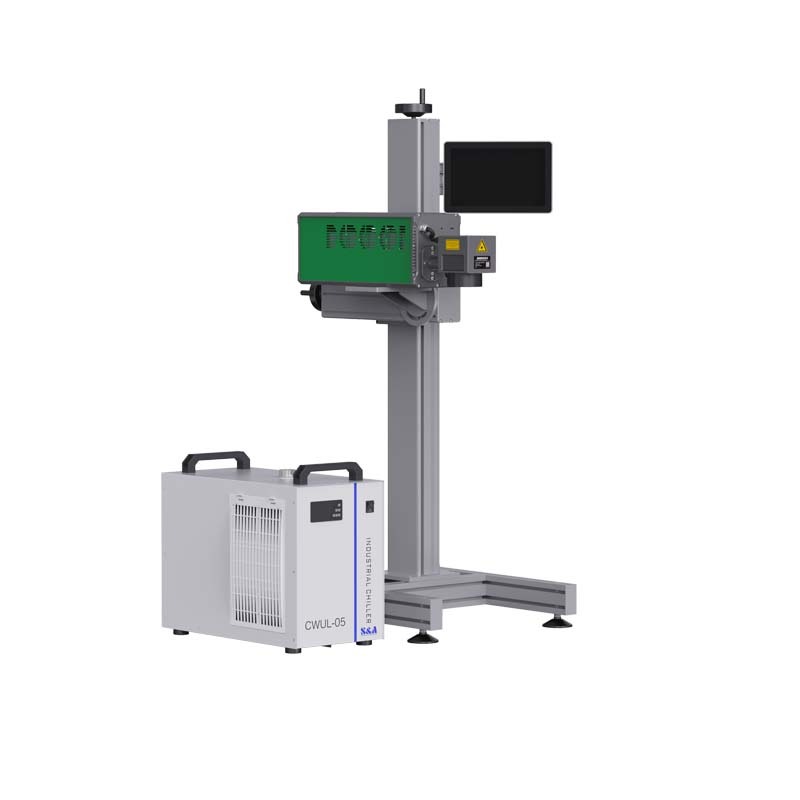
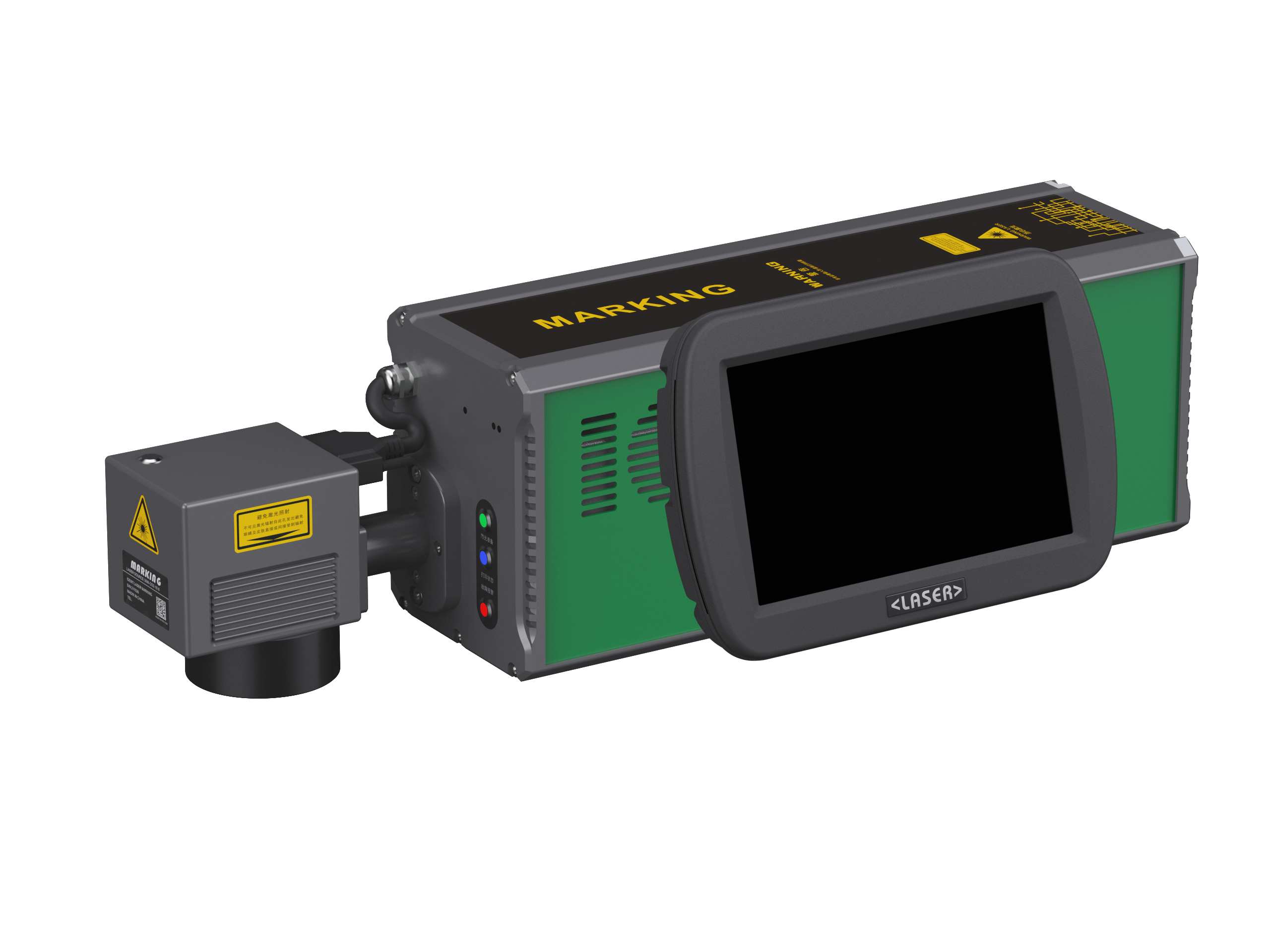
Built around a 355nm ultraviolet cold laser, the series produces a minimum line width of 0.01mm with 0.001mm repetition accuracy. This wavelength avoids thermal damage to heat-sensitive materials — glass, plastic, electronic components, coated surfaces — because the cold ablation process removes material without burning or discolouring the surrounding area. Each machine runs on a Linux-based controller with a 10.2-inch touch screen, supporting multi-language switching, power-off data protection, and external Ethernet connectivity. This flying laser marking for production line architecture means the conveyor never stops, preserving the throughput rate the line was designed for. As a 355nm UV laser marking system, the series marks materials that infrared lasers cannot handle without thermal damage.
The series is designed as a drop-in component for automated packaging lines, beverage bottling plants, pharmaceutical labelling stations, and electronics assembly lines. With the same footprint (640mm × 160mm × 206mm, 40kg) and mounting interface across all three models, a line can be upgraded from UV-3W to UV-10W without mechanical rework. The 355nm UV laser marking system is particularly suited to facilities that mark a variety of substrate materials on the same line, because the cold processing wavelength handles glass, plastics, metals, and ceramics without changing the marking head. Code quality is consistent across every substrate in the production mix.
Model Comparison
| Parameter | UV-3W | UV-5W | UV-10W |
|---|---|---|---|
| Laser Power | 3W | 5W | 10W |
| Actual Output Power | ≥4.2W | ≥6.5W | ≥12W |
Technical Specifications
UV-3W
| Product name | Online Flying UV Laser Marking Machine |
| Laser Power | 3W |
| Actual Output Power | ≥4.2W |
| Laser Wavelength | 355nm |
| Laser Service Life | 20000–30000 hours |
| Marking Speed | ≤12000mm/s |
| Focus Lens | 210mm |
| Minimum Linewidth | 0.01mm |
| Repetition Accuracy | 0.001mm |
| Marking Range | 110mm×110mm (Optional) |
| Positioning Mode | Blue light indication |
| Assembly Line Speed | 0–130m/min |
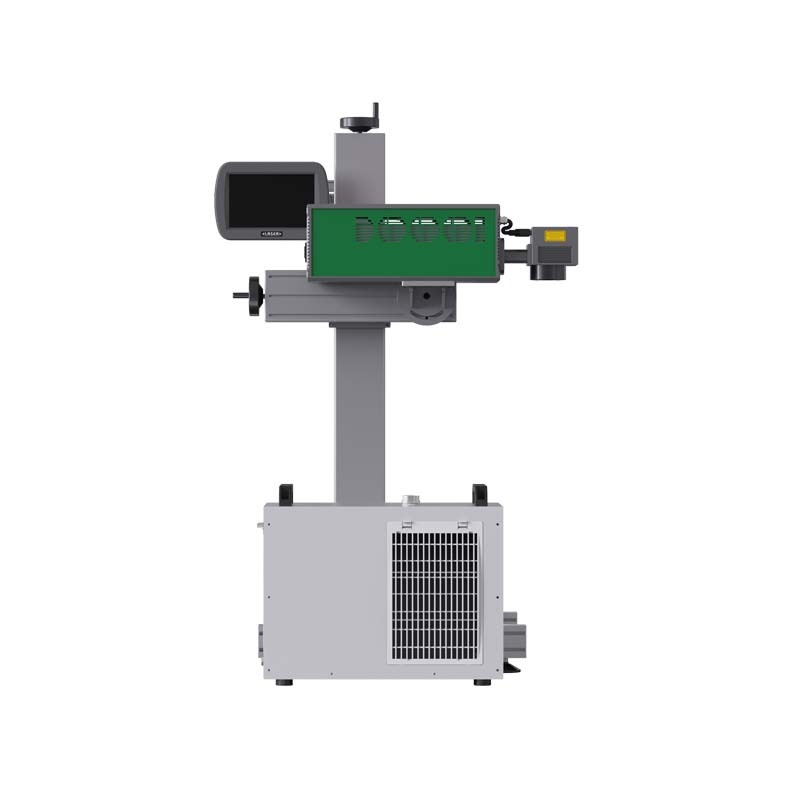
| Cooling System | Water cooling with chiller |
| Controller | 10.2 inch touch screen |
| Protection Grade | IP55 |
| Operating Voltage | 220V/50HZ |
| Total Power Consumption | 800W |
| Net Weight | 40kg |
| Overall Dimension | 640mm×160mm×206mm |
| Operating Temperature | 0℃–45℃ |
| Operating Humidity | ≤95% non-condensing |
| Operating System | Linux |
| Supported File Format | BMP/DXF/HPGL/JPEG/PLT |
The UV-3W delivers ≥4.2W actual output from its 3W-rated laser source. This margin between rated and actual power is characteristic of the 355nm pump architecture. At 800W total power consumption, the UV-3W is the most energy-efficient configuration for production lines that need cold marking on sensitive materials without the higher throughput of the 5W or 10W variants. Typical applications include batch number coding on pharmaceutical blister packs, date marking on flexible packaging films, and logo engraving on thin plastic components where minimal thermal penetration is critical. It is the entry point into the series for facilities that are switching from inkjet to laser coding for the first time. The cold laser marking machine architecture of the UV-3W delivers the same 355nm cold processing advantage as its larger siblings at the lowest operating cost per hour.
UV-5W
| Product name | Online Flying UV Laser Marking Machine |
| Laser Power | 5W |
| Actual Output Power | ≥6.5W |
| Laser Wavelength | 355nm |
| Laser Service Life | 20000–30000 hours |
| Marking Speed | ≤12000mm/s |
| Focus Lens | 210mm |
| Minimum Linewidth | 0.01mm |
| Repetition Accuracy | 0.001mm |
| Marking Range | 110mm×110mm (Optional) |
| Positioning Mode | Blue light indication |
| Assembly Line Speed | 0–130m/min |
| Cooling System | Water cooling with chiller |
| Controller | 10.2 inch touch screen |
| Protection Grade | IP55 |
| Operating Voltage | 220V/50HZ |
| Total Power Consumption | 800W |
| Net Weight | 40kg |
| Overall Dimension | 640mm×160mm×206mm |
| Operating Temperature | 0℃–45℃ |
| Operating Humidity | ≤95% non-condensing |
| Operating System | Linux |
| Supported File Format | BMP/DXF/HPGL/JPEG/PLT |
The UV-5W produces ≥6.5W actual output, placing it at the centre of the power range. It shares the same 800W total power consumption as the UV-3W, so the efficiency gain per watt of useful laser output is higher. This makes it the most common choice for lines that mark a mix of materials — from beverage bottle caps and cosmetic containers to cable sheathing and electronic housings — where the marking speed needs to keep pace with a mid-speed conveyor without sacrificing the cold-processing advantage of the 355nm wavelength. The 5W configuration handles barcodes, serial numbers, and 2D data matrix codes at production speeds without visible edge effects on coated or printed surfaces. As a mid-range online flying laser marking machine, the UV-5W covers the widest range of production line scenarios and is the configuration most frequently specified by packaging integrators. The 355nm UV laser marking system at this power level provides the best balance of throughput and precision for mixed-product lines.
UV-10W
| Product name | Online Flying UV Laser Marking Machine |
| Laser Power | 10W |
| Actual Output Power | ≥12W |
| Laser Wavelength | 355nm |
| Laser Service Life | 20000–30000 hours |
| Marking Speed | ≤12000mm/s |
| Focus Lens | 210mm |
| Minimum Linewidth | 0.01mm |
| Repetition Accuracy | 0.001mm |
| Marking Range | 110mm×110mm (Optional) |
| Positioning Mode | Blue light indication |
| Assembly Line Speed | 0–130m/min |
| Cooling System | Water cooling with chiller |
| Controller | 10.2 inch touch screen |
| Protection Grade | IP55 |
| Operating Voltage | 220V/50HZ |
| Total Power Consumption | 800W |
| Net Weight | 40kg |
| Overall Dimension | 640mm×160mm×206mm |
| Operating Temperature | 0℃–45℃ |
| Operating Humidity | ≤95% non-condensing |
| Operating System | Linux |
| Supported File Format | BMP/DXF/HPGL/JPEG/PLT |
The UV-10W delivers ≥12W actual output, the highest in the series. At the same 800W total power consumption, it produces nearly three times the useful laser power of the UV-3W, making it the configuration for high-speed lines that cannot afford a second pass. Deep marking on metal surfaces, high-contrast codes on dark plastics, and serialisation on automotive components all benefit from the additional power budget. The 10W output also supports a larger depth of field, so minor variations in product height on the conveyor do not require focus adjustment during production. The UV-10W laser marking machine is the flagship configuration for facilities that run their lines above 80m/min and require permanent marks on the hardest substrates in the series’ material range. This cold laser marking machine delivers the highest power margin in the product family, making it the choice for demanding industrial environments.
Product Features
Dynamic flying marking for production lines
Each machine in the series integrates a photoelectric sensor and encoder synchronous tracking system that reads the conveyor speed in real time and synchronises the laser firing to the moving product. The system supports line speeds from 0 to 130m/min and works with both static and flying marking modes. The software compensates for position drift automatically, so codes, logos, and batch numbers land in the correct location regardless of product spacing on the line. This flying laser marking for production line design eliminates the need for indexing stops or mechanical product separators, which is a key advantage of the 355nm UV laser marking system for high-speed packaging applications.
355nm ultraviolet cold laser source
The 355nm wavelength produces a photon energy high enough to break molecular bonds directly — a process called cold ablation — without generating the heat-affected zone that infrared or CO₂ lasers leave behind. This is what allows the series to mark glass, plastic, electronic components, and coated materials without cracking, burning, or discolouration. The minimum line width of 0.01mm and 0.001mm repetition accuracy support micro-marking of tiny text, barcodes, and QR codes at production speeds. The 355nm UV laser marking system approach is particularly valued in food and pharmaceutical packaging, where thermal damage to the substrate could compromise the seal or the product itself. Every unit in the series benefits from this cold processing advantage.
Intelligent software and control system
The Linux-based controller with a 10.2-inch touch screen provides multi-language switching, power-off data protection, overspeed alarm, automatic cross-line removal, and multi-user authority management. The system supports single- and dual-machine coding and offers remote operation via external Ethernet. Files in BMP, DXF, HPGL, JPEG, and PLT formats load directly without conversion, and the marking parameters for each product SKU can be stored and recalled on the production line. The entire series shares the same software interface, so operators trained on one model can run any of the three without retraining.
Full production line signal integration
Serial port and network port communication are standard, with reserved signals for start, print completion, and fault alarm. The machines can connect to upper-level PLCs, SCADA systems, and visual inspection equipment, enabling seamless integration into automated production lines without additional interface hardware. The signal protocol is compatible with the majority of industrial automation standards used in packaging, beverage, and pharmaceutical lines. This connectivity is a standard feature of the 355nm UV laser marking system regardless of which power configuration is selected.
Cold processing for a wide material range
The cold ablation mechanism applies to hard, soft, and brittle materials alike. Glass bottles, plastic caps, ceramic packaging, electronic PCBs, anodised aluminium, and coated paperboard all mark cleanly without burn marks, edge melt, or substrate deformation. The thermal impact is localised to the interaction zone, so adjacent printed graphics or sensitive components remain unaffected. This material versatility is a defining advantage of the 355nm wavelength over fibre and CO₂ alternatives. The cold laser marking machine design of the series eliminates the need for substrate-specific consumables or pre-treatment chemicals.
Water-cooled, IP55-rated long-term operation
A water cooling constant temperature system paired with a chiller maintains the laser module at its operating temperature across ambient conditions from 0°C to 45°C. The laser service life reaches 20,000–30,000 hours. The IP55 protection grade seals the enclosure against dust ingress and low-pressure water jets from any direction, making the series suitable for the particulates, washdowns, and humidity found in food, beverage, and pharmaceutical production environments. The cold laser marking machine architecture also means there are no ink residues, solvent fumes, or printhead cleaning chemicals to manage in the production area.
Business Value
For production managers and line integrators, the primary value of the series is the elimination of consumables. Unlike inkjet coders that require constantly replaced printheads, solvents, and ink cartridges, these laser markers operate on electrical power alone — no ink, solvents, or printhead replacements are required. Over a multi-year production run, the only recurring cost is the electricity drawn by the 800W system and the chiller. The total cost of ownership advantage widens as the line speed increases, because inkjet systems consume more ink per mark at higher speeds while the laser’s power draw remains constant. Any unit in the series delivers this same consumable-free operating model.
The series also removes the quality variation inherent in wet-marking processes. Inkjet codes can smudge, drip, or fade depending on substrate surface energy, ambient humidity, and line speed. A laser mark is permanent, high-contrast, and identical from the first unit to the last. For regulated industries — pharmaceuticals, medical devices, food contact packaging — this consistency simplifies compliance with traceability and serialisation mandates such as UDI, GS1, and EU FIC. The 355nm UV laser marking system produces codes that withstand the sterilization, washing, and abrasion testing required in these sectors.
All three models share the same physical footprint, mounting pattern, electrical interface, and software environment. A production line tooled for the UV-3W can be upgraded to the UV-5W or UV-10W by swapping the marking head alone, without rewiring the control cabinet or modifying the conveyor mounting bracket. This modularity protects the line investment and allows a single spare machine to serve as a backup for any power configuration in the plant. A facility that standardises on the series across multiple lines carries one spare parts inventory, one set of operator manuals, and one maintenance schedule.
The 20,000–30,000 hour laser service life translates to 6–10 years of single-shift operation or 2–3 years of continuous 24/7 production before a laser module replacement is needed. During that period, the water-cooled, sealed design requires no routine consumable replenishment and minimal preventive maintenance beyond chiller coolant checks and lens cleaning. The flying laser marking for production line architecture also improves OEE by eliminating the stop-and-mark station cycle time that mechanical or pneumatic coding systems require. This is a direct throughput advantage that every cold laser marking machine in the series brings to the production floor.
Applications
The UV-3W configuration suits production lines where the primary materials are heat-sensitive and the marking requirement is limited to batch numbers, date codes, and simple logos. Pharmaceutical blister packaging lines, where the cold laser marks through the transparent film without damaging the medication inside, are a natural fit. Flexible packaging for snacks and confectionery — coated films, metallised laminates, and polypropylene pouches — mark cleanly at line speeds without burn-through or edge melting. The UV-3W also handles thin-walled plastic containers for cosmetics and personal care products, where any thermal distortion would reject the part. It is the recommended configuration for facilities that are deploying a cold laser marking machine in a production environment for the first time and want to validate the technology at minimal power cost.
The UV-5W serves mid-speed beverage bottling lines, where the conveyor runs at 30–80m/min and the marking surface alternates between glass, PET, and aluminium caps. The 5W output provides enough power to mark through the surface tension of curved glass bottles and the lubricant residue on aluminium pull-tab caps without slowing the line. Electronic assembly lines that mark PCB serial numbers, connector housings, and cable sheathing also benefit from the balance of speed and precision the UV-5W offers. The same machine can shift between marking a flexible circuit board one minute and a metal-shielded connector the next, because the 355nm wavelength couples well with both polymer and metal surfaces. For integrators who need a single online flying laser marking machine that handles a diverse product portfolio, the UV-5W is the most frequently specified option.
The UV-10W targets high-speed lines where the product moves above 80m/min and the mark needs to be visible on dark or textured surfaces. Automotive component lines — brake calipers, fuel injectors, sensor housings — require deep, permanent marks that survive assembly lubrication and subsequent handling. The 10W output delivers the contrast needed for Data Matrix codes on cast iron and aluminium parts without pre-treatment. Pharmaceutical serialisation lines that apply 2D codes at the unit, bundle, and case level benefit from the depth of field, which keeps codes in focus across the variations in carton thickness and stack height. The UV-10W laser marking machine is also the recommended configuration for marking ceramic and glass packaging in the premium spirits and cosmetics sectors, where the code must be invisible to the naked eye under normal lighting yet readable under inspection. High-speed dairy and beverage lines that run above 100m/min rely on the UV-10W’s power margin to maintain clear marks at full production rate.
Quality & Safety
The IP55 protection grade ensures the marking head and control electronics are sealed against dust ingress and low-pressure water jets. This is relevant for food and beverage production environments where washdown cleaning is routine, and for pharmaceutical facilities where airborne particulates from tablet compression or powder filling are present. The water cooling constant temperature system keeps the laser diode within its operating window regardless of ambient conditions between 0°C and 45°C, preventing thermal drift that could affect marking consistency across seasons. The series is built to maintain stable operation through these environmental variations.
The series includes overspeed alarm and automatic cross-line removal as software-level safeguards. If the conveyor speed exceeds the configured threshold, the system pauses marking rather than applying misaligned codes. The automatic cross-line removal function detects overlapping or partial marks caused by product position shift and suppresses them, preventing unreadable codes from reaching the downstream inspection station. Each machine ships with laser safety goggles as standard personal protective equipment, and the enclosure design localises the laser emission to the marking window. The 355nm UV laser marking system operates at a wavelength that is absorbed by standard polycarbonate laser safety eyewear, and the enclosure design means no additional interlock or safety zone is required when the machine is installed in its closed configuration.
Why Choose This UV Fly Laser Marking Machine
The series offers three power levels in a single mechanical and software platform, which means a production facility can standardise on one maintenance protocol, one spare parts inventory, and one operator training programme regardless of which model each line uses. The 355nm cold laser source expands the material range beyond what CO₂ or fibre lasers can handle without damage — glass, plastics, ceramics, coated metals, and electronics all mark without charring, cracking, or discolouration. The flying laser marking for production line architecture with photoelectric sensor and encoder tracking eliminates the need for product indexing or stop-and-mark stations, preserving the line speed the production planner specified.
The Linux-based control system with multi-language interface and remote Ethernet operation reduces the integration effort for facilities that already use industrial PLCs and SCADA systems. Each machine ships with a UDisk, positioning bar, power cable, USB cable, hexagonal wrench, color aluminum sheet, goggles, and foot switch, so the only additional equipment required is the chiller and the conveyor mounting bracket. The entire series is designed for production environments where uptime, repeatability, and material versatility are the primary purchasing criteria, and where the transition from consumable-based coding to permanent laser marking needs to be operationally seamless. As a 355nm UV laser marking system, the series delivers code permanence and substrate safety that inkjet and thermal transfer systems cannot match.
FAQ
Q1: What is the difference between the UV-3W, UV-5W, and UV-10W models?
A: The three models differ in laser power and actual output power: the UV-3W delivers ≥4.2W, the UV-5W delivers ≥6.5W, and the UV-10W delivers ≥12W. All other specifications — including wavelength (355nm), marking speed (≤12000mm/s), minimum linewidth (0.01mm), repetition accuracy (0.001mm), physical dimensions (640mm×160mm×206mm), weight (40kg), total power consumption (800W), protection grade (IP55), cooling system (water cooling with chiller), and controller (10.2-inch touch screen, Linux OS) — are identical. The choice depends on the required marking depth, line speed, and substrate material; higher power models handle faster lines and more demanding materials.
Q2: Which model should I choose for marking glass bottles?
A: All three models can mark glass bottles, since the 355nm cold laser does not generate thermal stress on glass surfaces. The UV-3W is sufficient for low-speed lines (up to 50m/min) marking simple date codes. The UV-5W is recommended for mid-speed lines (30–80m/min) where the mark needs to be visible through the glass curvature. The UV-10W suits high-speed lines above 80m/min or when marking dark-coloured glass where contrast is harder to achieve.
Q3: Can this machine mark moving products on a conveyor without stopping?
A: Yes. The series is designed for dynamic flying marking. A photoelectric sensor detects the product position, and an encoder tracks the conveyor speed in real time. The laser fires synchronised with the moving product, supporting line speeds from 0 to 130m/min without requiring the product to stop for marking. This flying laser marking for production line approach is the core differentiator of the series compared to stationary marking systems.
Q4: What materials can the 355nm UV laser mark?
A: The 355nm wavelength marks glass, plastics (including PP, PE, PET, ABS, PC, and acrylic), ceramics, coated metals, anodised aluminium, electronic components, PCBs, paperboard, and coated packaging films. The cold ablation mechanism prevents burning, charring, or melting on these materials, which is a common limitation of CO₂ or fibre lasers on thin plastics and reflective surfaces. As a 355nm UV laser marking system, the series can mark materials that are transparent or highly reflective to infrared wavelengths.
Q5: What file formats does the control system accept?
A: The Linux-based controller supports BMP, DXF, HPGL, JPEG, and PLT formats. Files can be loaded via USB drive or transferred over Ethernet. The system stores marking parameters per SKU for quick recall on the production line.
Q6: How long does the laser source last?
A: The laser service life is rated at 20,000–30,000 hours, depending on the operating power level and ambient conditions. The water cooling constant temperature system with chiller maintains the laser diode at its optimal operating temperature, which contributes to reaching the upper end of this range in typical production environments.
Q7: What is the IP55 protection rating and why is it important for a UV Fly Laser Marking Machine?
A: IP55 means the enclosure is dust-protected (limited ingress of dust, not harmful to operation) and protected against low-pressure water jets from any direction. This is important for production environments where washdown cleaning is routine, or where airborne particulates from packaging, filling, or processing operations are present. The rating ensures the machine continues operating reliably in these conditions.
Q8: Does the machine integrate with existing production line PLCs?
A: Yes. The machine communicates via serial port or network port, with reserved signals for start, printing completion, and fault alarm. It can connect to upper-level PLCs, SCADA systems, and visual inspection equipment for seamless integration with automated production lines.