

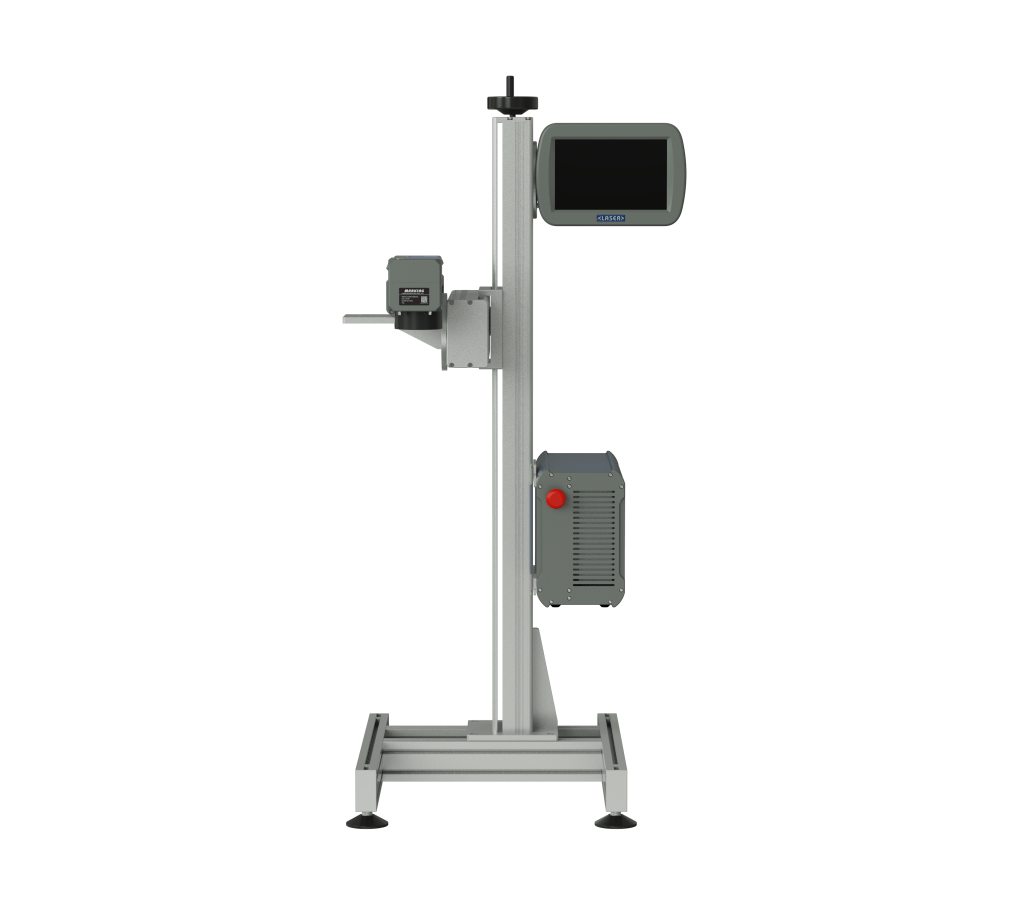
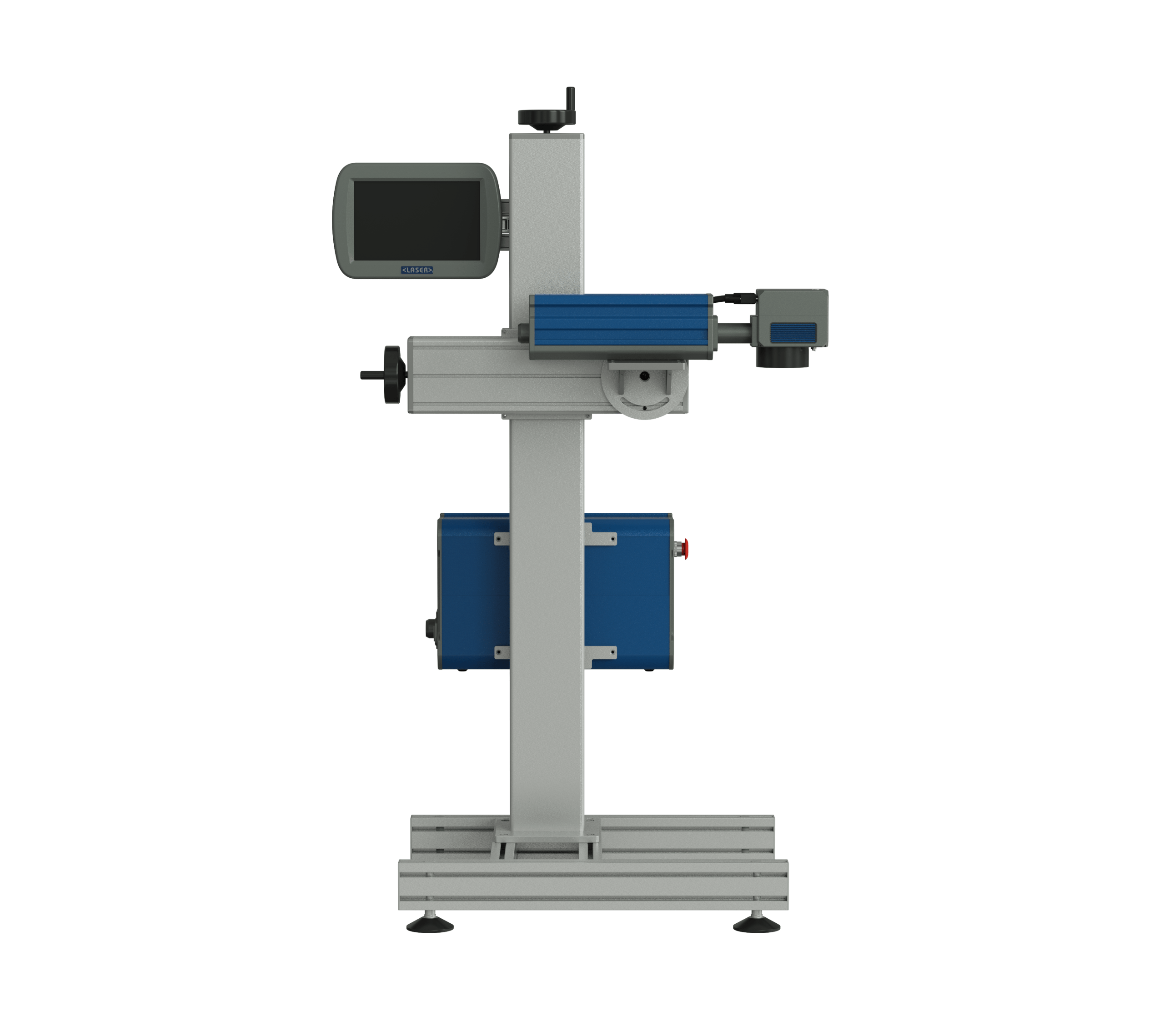
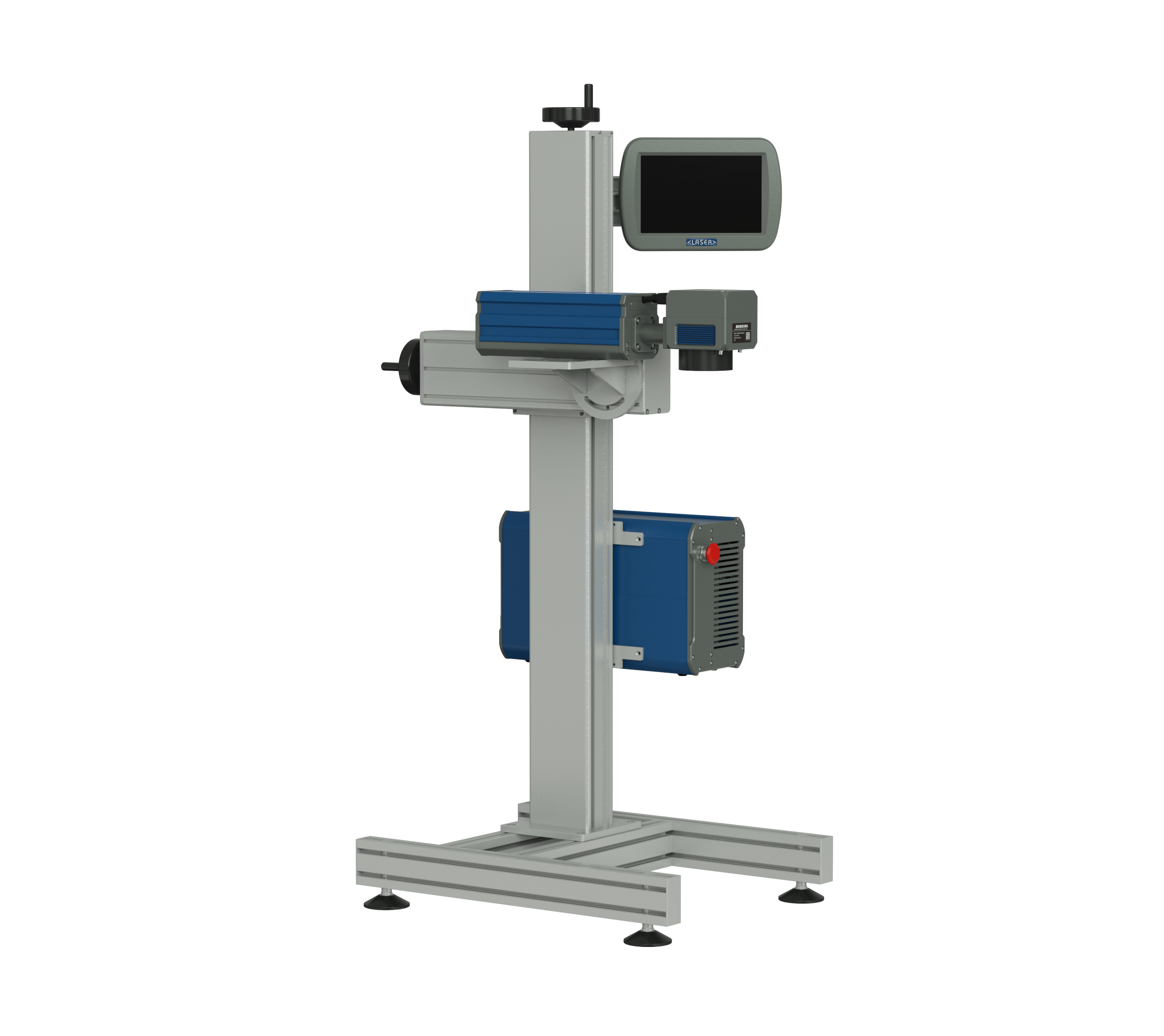
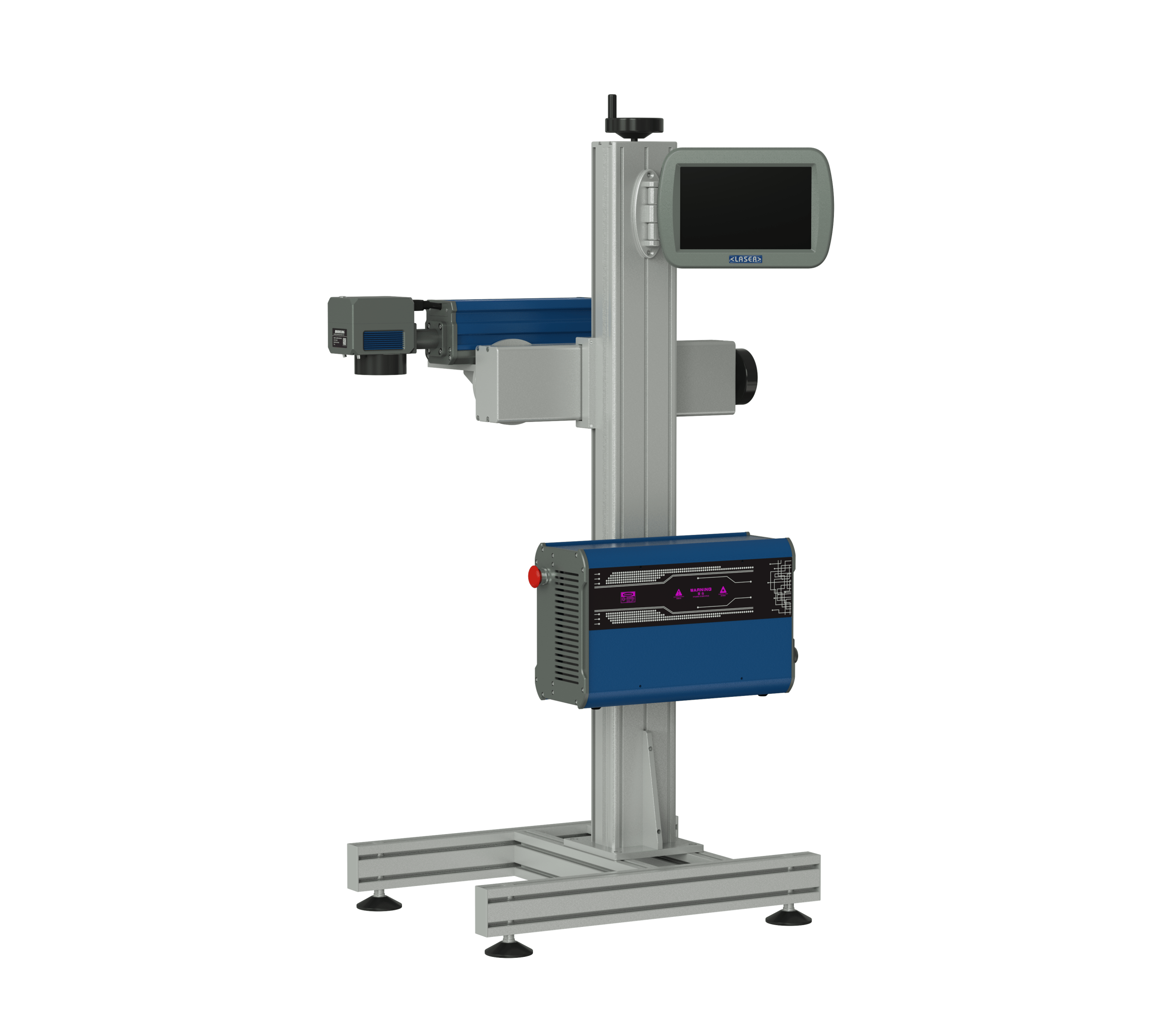

Product Overview
The flight marking machine is a dedicated fiber laser marking system engineered for online dynamic marking on automated assembly lines. Available in 10 W, 20 W, and 30 W output configurations, this fiber laser marking machine delivers permanent, high-contrast marks on metals, plastics, and packaging materials without interrupting continuous production flow. Equipped with a high-speed galvanometer scanning system, this laser marking system achieves engraving line speeds of up to 12000 mm/s while maintaining a repeat accuracy of ±0.001 mm. The marking scope can be configured from 110×110 mm up to 300×300 mm, making this flight marking machine adaptable to components of varying sizes on the same production line. Its air-cooled design and 220 V / 50 Hz power requirement simplify installation and integration into existing manufacturing environments. As a true online marking machine, it supports real-time marking triggered by conveyor sensors or encoder pulses for synchronised production flow.
Technical Specifications
| Product name | Flight marking machine |
| Scope of marking | 110×110/150×150/300×300(mm) |
| Laser wavelength | 1060nm |
| Beam quality | m2<1.5 |
| Minimum line width | 0.01mm |
| Minimum characters | 0.05mm |
| Repeat accuracy | +0.00Imm |
| Engraving line speed | ≤12000mm/s |
| Supplyvoltage | 220v/50HZ/10A |
| Cooling mode | Air cooling |
| Overall power | 200W |
| Repetition rate | ≤100KHZ |
Product Features
Online Dynamic Marking for Continuous Production
The defining capability of this fiber laser marking machine is its suitability for online dynamic marking. Unlike stationary laser markers that require parts to be loaded and unloaded individually, this flight marking machine marks products in motion along the assembly line. It synchronises with line speed to apply texts, serial numbers, QR codes, and patterns in real time, eliminating the need for a separate offline marking station. This directly supports lean manufacturing principles by reducing handling steps and work-in-progress inventory. As a flying marking machine, it maintains mark quality even when the conveyor operates at variable speeds.
Selectable Laser Power 10 W / 20 W / 30 W
The flight marking machine offers three power grades to match different throughput and material requirements. The 10 W configuration suits thin plastics, coated metals, and packaging films where shallow marking depth is sufficient. The 20 W option provides a balanced combination of speed and penetration for general industrial marking on metals and engineering plastics. The 30 W variant delivers the strongest marking efficiency and deepest penetration, ideal for hardened metal parts, thick coatings, and high-line-speed environments where dwell time per part is minimal. All three power options share the same optical path and control interface, allowing straightforward field upgrades without replacing the entire laser marking system.
High-Speed Galvanometer Scanning System
At the core of this online marking machine is a high-speed galvanometer that drives the laser beam across the marking field with precision. The system achieves engraving line speeds up to 12000 mm/s and a minimum line width of 0.01 mm, producing crisp characters and fine detail on small components. The beam quality of M² < 1.5 ensures a focused spot with consistent energy distribution across the entire marking range, so marks at the edges of the field are as clear as those at the centre. This is critical for batch traceability codes where every dot must be readable by downstream vision systems.
Wide Marking Scope with Flexible Configuration
The marking scope can be set to 110×110 mm, 150×150 mm, or 300×300 mm by selecting the appropriate F-theta lens. This modular approach lets manufacturers match the field size to their typical part dimensions — a smaller field for higher energy density on small components, or a larger field for marking multiple parts in a single pass. The 300×300 mm configuration is particularly useful for marking large panels, trays, or grouped small parts on a conveyor. The F-theta lens is one of the key optical accessories — along with the fiber cable, beam expander, and reflective mirror — that ship with this flight marking machine to form a complete marking head assembly.
Stable Structure and Strong System Compatibility
The flight marking machine features a rigid frame and stable mounting that maintains optical alignment under continuous production conditions. Its control interface supports standard I/O communication protocols for seamless integration with PLCs, encoders, and conveyor systems. The machine can be triggered by photoelectric sensors or encoder pulses to mark at exact positions regardless of line speed fluctuations. This compatibility reduces integration engineering time and makes this fiber laser marking machine suitable for both new production lines and retrofit projects.
Business Value
For manufacturers operating automated assembly lines, the flight marking machine converts a non-value-added handling step — moving parts to a stationary marking station — into an inline process that keeps pace with production. The elimination of offline marking reduces labour requirements and eliminates the risk of part mix-ups between marking and assembly. With engraving speeds up to 12000 mm/s, this laser marking system does not become a bottleneck even on high-throughput lines. The online marking machine continuously applies date codes, batch numbers, and 2D data matrix codes at full line speed.
The selectable power range from 10 W to 30 W enables a single machine platform to handle multiple product lines by simply adjusting the laser power setting or swapping the F-theta lens. This reduces capital equipment duplication and simplifies spares inventory. The air-cooled design eliminates the ongoing cost and maintenance of chiller systems, and the 220 V single-phase power requirement means no three-phase upgrade is needed in most facilities.
Permanent laser marking carries intrinsic business advantages over inkjet or labelling alternatives. There are no consumables — no inks, solvents, ribbons, or labels to replenish. Mark integrity does not degrade over time or with exposure to heat, chemicals, or abrasion, which reduces liability in warranty and recall scenarios. For regulated industries such as food packaging and electronics manufacturing, the indelible mark provides a verifiable chain of traceability that supports compliance with track-and-trace requirements. The flight marking machine delivers these benefits without slowing down the assembly line.
Applications
Food and Beverage Packaging. The flight marking machine applies production dates, batch numbers, and QR codes on plastic films, coated cartons, and metal cans moving at line speed. The non-contact marking process does not puncture packaging films or compromise seal integrity, making it suitable for high-speed packaging lines. The fiber laser marking machine handles the variety of substrate colours and surface finishes found in food packaging without adjustment.
Electronics Manufacturing. Small electronic components such as connectors, PCBs, switches, and modules are marked with serial numbers, logos, and identifiers at rates that match pick-and-place throughput. The minimum character height of 0.05 mm allows legible marking on the smallest surface-mount devices.
Daily Chemical and Personal Care. Bottles, tubes, and caps made from HDPE, PP, PET, and coated glass receive permanent date codes and lot numbers on filling and capping lines. The mark resists smearing from handling and washing, which is important for products that go through wet environments during use.
Automotive Parts. Metal and plastic components such as brake pads, sensors, connectors, and housings are marked with part numbers, date codes, and supplier codes on engine and chassis assembly lines. The deep engraving capability of the 30 W configuration ensures marks survive subsequent painting, heat treatment, and handling processes.
Pharmaceutical and Medical Device. Blister packs, syringes, vials, and surgical instruments are marked with unit-level serialisation codes that support track-and-trace requirements. The clean, consumable-free marking process is suitable for controlled manufacturing environments.
Why Choose This Flight Marking Machine
This fiber laser marking machine addresses the specific challenge of inline marking on high-speed assembly lines where any interruption reduces throughput. Its galvanometer-based scanning system operates at line speeds and marks moving parts without requiring a stop-and-mark cycle. The three power options let buyers select the right energy level for their material mix without over-specifying. As an online marking machine, it is engineered from the ground up for production-line integration rather than adapted from a stationary platform.
The machine ships with the essential optical accessories needed for installation: fiber cable, F-theta lens (field lens), beam expander, and reflective mirror set. This means the buyer receives a complete marking head assembly that can be mounted directly above the conveyor without sourcing additional optics. The standard 220 V / 50 Hz single-phase electrical requirement and air-cooled thermal management simplify facility planning across different regions.
Every flight marking machine unit is supported by a straightforward maintenance routine: cleaning the reflective mirror and F-theta lens periodically, and checking the beam expander alignment. The solid-state laser source has no lamps to replace and no consumable parts to stock, keeping the total cost of ownership low over the machine’s service life.
FAQ
Q1: What is the difference between a flight marking machine and a stationary laser marker?
A: A flight marking machine is designed for online dynamic marking — it marks products while they move along a conveyor or assembly line. A stationary laser marker requires the part to be stopped and positioned before marking. The flight marking machine synchronises with line speed using sensor or encoder signals, so production flow continues uninterrupted. This makes it a true online marking machine for continuous production environments.
Q2: Which materials can this fiber laser marking machine mark?
A: It marks most metals including steel, stainless steel, aluminium, brass, and copper, as well as engineering plastics such as ABS, PC, PA, and PBT, plus coated materials and packaging films. The 10 W setting handles plastics and thin coatings, while 20 W and 30 W settings penetrate deeper into metals and thick coatings.
Q3: What marking scope sizes are available?
A: Three F-theta lens options provide marking fields of 110×110 mm, 150×150 mm, and 300×300 mm. The choice depends on the largest part dimension on your line. The lens can be swapped to change the field size without modifying the rest of the optical train. All three lens options are available with the flight marking machine.
Q4: Can the flight marking machine integrate with my existing PLC and conveyor system?
A: Yes. The control system accepts standard I/O signals from photoelectric sensors and encoder pulse inputs, and can communicate with common PLC brands. The laser marking system marks at the exact position determined by the sensor or encoder, automatically compensating for line speed variations.
Q5: What is the minimum character size this flight marking machine can produce?
A: The minimum character height is 0.05 mm, and the minimum line width is 0.01 mm. This enables legible serial numbers and data matrix codes on very small electronic components or medical devices. The repeat accuracy of ±0.001 mm ensures every mark is placed at the intended position within tight tolerances.
Q6: Is air cooling sufficient for continuous production running?
A: Yes. The overall electrical power consumption is 200 W, and the air cooling system is designed for continuous operation in factory environments. No chiller or compressed air connection is needed for the basic system, which reduces installation complexity and ongoing maintenance.
Q7: What optical accessories are included with this laser marking system?
A: The machine ships with a fiber cable, F-theta lens (field lens), beam expander, and reflective mirror set. These components form the complete beam delivery and focusing system required for marking. The reflective mirror directs the beam path from the laser source to the galvanometer, and periodic cleaning of this mirror is recommended to maintain consistent marking quality.
Q8: How does the 30 W configuration improve marking on metal parts?
A: The 30 W laser source delivers higher peak energy per pulse, which creates deeper and more visible marks on hardened steel, cast iron, and anodised aluminium. It also enables faster marking at a given depth, which is important when line speed is high and dwell time per part is short. For buyers marking mostly metals, the 30 W flight marking machine configuration is the recommended choice.