

Product Overview
The 1500W handheld laser welding machine delivers fast, precise metal joining in a compact all-in-one cabinet. Operating at 1070nm wavelength through a 20μm fiber core, this laser welding machine reaches welding speeds 3–10 times faster than traditional argon arc welding while producing a minimal heat-affected zone. The 10m long fiber cable and handheld swing welding head let operators access large-area workpieces without repositioning the cabinet. A dual-temperature water chiller maintains stable cooling during extended production runs, and the touch control panel requires no complex programming. The unit accepts 380V±10% input at ≤13.5KW total power and operates reliably across 15–35°C. The integrated cabinet houses the laser source, chiller, and control electronics in a single footprint under one square meter, simplifying workshop layout and reducing installation time. For a shop adding a new welding capability, this fiber laser welding machine replaces both the TIG workstation and the grinding station in a single equipment purchase.
Technical Specifications
| Product name | Handheld Laser Welding Machine |
| Laser Power | 1500W |
| Laser Wavelength | 1070nm |
| Fiber Core Diameter | 20μm |
| Fiber Length | 10m |
| Working Mode | Continuous / Modulated |
| Adjustable Weld Width | 0.5–6mm |
| Scanning Speed | ≤6000mm/s |
| Welding Speed | 0–120mm/s |
| Max. Weldable Thickness | ≤10mm |
| Allowable Welding Gap | ≤0.5mm |
| Cooling System | Dual-temperature Water Chiller |
| Input Voltage | 380V±10% |
| Total Power | ≤13.5KW |
| Operating Temperature | 15–35℃ |
| Operating Humidity | <70%, non-condensing |
Product Features
Fast Welding Speed & Minimal Distortion
This 1500W laser welder runs 3–10 times faster than argon arc welding on equivalent joints. The narrow heat-affected zone keeps workpieces free from deformation and discoloration, while the firm welding seam meets structural standards without post-weld finishing. Each unit delivers consistent bead geometry across repeated runs on stainless steel, mild steel, and galvanized sheet within the ≤10mm thickness range. A fabrication shop welding 200 3mm-thick brackets per day on argon arc could produce 600–800 pieces per day with this machine using the same operator.
Handheld Swing Welding Head with 6 Modes
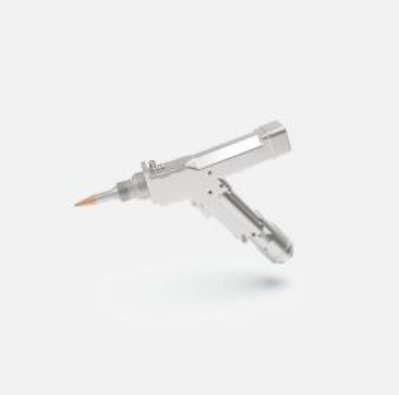
The handheld welding head features a spiral swing function that adjusts weld width continuously from 0.5mm to 6mm. Six built-in welding modes cover butt, lap, fillet, corner, edge, and overlap joints, and multiple interchangeable nozzles let operators match the beam profile to the joint geometry. The swing mechanism distributes the 1500W beam evenly across the weld pool, producing a smooth, uniform surface on both thin sheet and thick plate. For a kitchen equipment manufacturer switching from TIG to this handheld laser welder, the learning curve is limited to one afternoon of practice on scrap material.
Safe Induction Laser Emission
The laser emits only when the nozzle contacts the workpiece. Lifting the head from the metal surface triggers an automatic lock that stops emission immediately, removing the risk of accidental firing during positioning or idle handling. This contact-sensing design meets Class 4 laser safety requirements for handheld beam delivery and does not require an external foot pedal or remote interlock. Operators can set the head down on the workbench between joints without powering down the chiller, which maintains the laser diode temperature during short pauses.
Reliable 1500W Fiber Laser Source
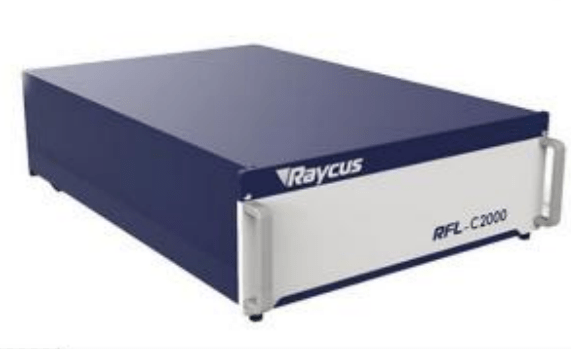
A Raycus or RECI 1500W fiber laser source drives the beam at 1070nm with a stable fundamental mode and high photoelectric conversion efficiency. The fiber-coupled architecture delivers a clean, focused spot through the 20μm core, producing consistent penetration across the full 0.5–6mm weld width range. Both laser brands are widely used in industrial fabrication, and replacement diodes are available through standard supply channels. For a metal laser welding machine operating eight hours daily, the diode lifetime typically exceeds 50,000 hours before any power degradation is measurable.
10m Fiber Cable for Large-Area Flexibility
The 10-meter standard fiber cable lets operators work on large assemblies, long seams, and overhead positions without moving the cabinet. The cable carries the full 1500W output with minimal loss, supporting continuous welding strokes across extended workpieces. For a fabrication shop processing 3-meter sheet metal panels, the operator can weld the entire seam in a single pass without pausing to reposition the machine. The cable sheathing is armoured against workshop floor hazards, and the connector latches securely to prevent accidental disconnection during a weld pass.
Intelligent Dual-Temperature Water Chiller
The dual-temperature water chiller separates cooling circuits for the laser source and the welding head. Independent temperature control keeps both components within their optimal operating range during extended runs, prolonging service life and preventing thermal drift on the beam output. The chiller maintains the laser diode temperature even when the ambient workshop temperature reaches 35°C, ensuring consistent power delivery throughout the work shift. The closed-loop cooling system uses distilled water, eliminating scale buildup and reducing maintenance to a quarterly coolant check.
Simple Touch Control Panel
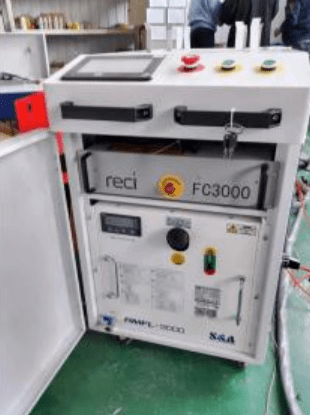
The touch panel displays all key parameters — laser power, weld width, speed, and mode selection — on a single screen. Operators select a preset for their material and thickness and start welding without any programming knowledge. New staff typically achieve production-ready quality within the first shift, and the panel stores the last-used settings so recurring jobs do not require re-entry. The panel interface is available in multiple languages, supporting a multi-national workshop workforce.
Compact All-in-One Cabinet Design
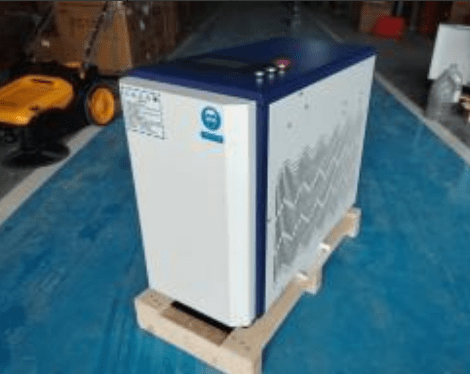
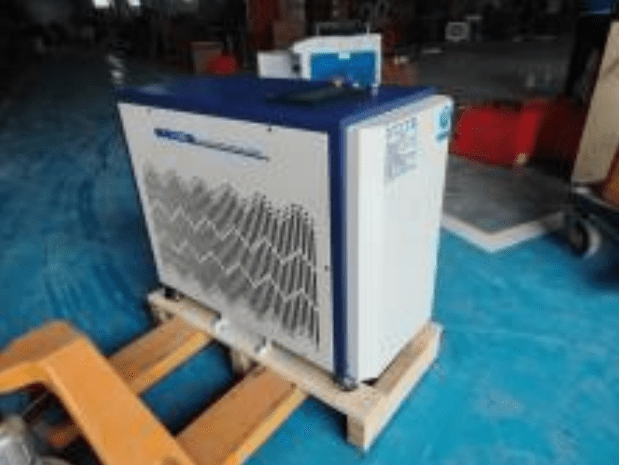
The integrated cabinet houses the laser source, chiller, control system, and power supply in a single unit occupying less than one square meter of floor space. Total power draw stays at ≤13.5KW, and the system operates steadily across 15–35°C ambient temperature without additional climate control. A single 380V three-phase connection is sufficient, and the cabinet includes casters for repositioning within the workshop. Unlike a traditional laser welding workstation that requires a separate chiller unit, power supply rack, and control cabinet, this machine arrives as a single skid that can be wheeled off the delivery truck and into production within 30 minutes of electrical connection.
Business Value
Switching from argon arc to this handheld laser welding machine cuts per-joint time by 60–85%, directly reducing labour cost per part. The absence of post-weld grinding or polishing eliminates a secondary finishing step and the consumables it requires — no grinding wheels, wire brushes, or chemical passivation agents. The 10m fiber cable and one-square-meter footprint mean no overhead crane or conveyor repositioning is needed; the operator carries the head to the workpiece rather than moving the workpiece to the machine. The dual-temperature chiller and proven Raycus/RECI source keep unscheduled downtime low, and the touch panel lets a shop reassign operators between tasks without retraining. For a fabrication shop running multiple stations, the per-unit throughput gain and the reduced floor-space requirement combine to lower the cost of added capacity. The 1-year warranty further reduces the total cost of ownership by covering the laser source and chiller, which are the two highest-value components in the system. A job shop processing 50 stainless steel panels per day recovers the machine investment within 6–8 months purely from the labour savings on weld and finishing time. This laser welding machine delivers a measurable return on investment that a fabrication manager can forecast using the shop’s current part volume, joint length, and operator hourly rate.
Applications
This laser welding machine handles sheet metal fabrication, kitchen equipment manufacturing, automotive panel repair, cabinet and enclosure assembly, and railing or stair construction. The 0.5–6mm adjustable weld width covers thin stainless steel sheet for food-processing equipment and thicker mild steel plate for structural frames. The modulated working mode suits heat-sensitive assemblies where controlled energy input prevents distortion on adjacent components — for example, welding brackets onto thin-walled enclosures without warping the panel face. For job shops that batch-process varied parts, the six welding modes and quick nozzle change let the operator switch between butt joints, lap joints, and corner welds without stopping the line. The ≤10mm penetration limit covers the majority of light-to-medium fabrication tasks, and the ≤0.5mm allowable gap tolerance reduces fit-up time on imperfectly sheared edges. Automotive repair shops use the handheld head to weld body panels in situ, eliminating the need to disassemble and reclamp the part on a bench. A metal laser welding machine of this power class is also used in elevator manufacturing for wall panel seams, where the 10m cable lets the operator follow the full 2.5-meter panel height in one continuous vertical stroke. Custom furniture fabricators weld stainless steel table legs and frames without visible seam lines, and the lack of spatter means no masking or protective film is needed on visible surfaces. Small-batch production runs benefit from the rapid mode switching, as a single operator can move from a thick-plate structural weld to a thin-sheet decorative joint within one minute of parameter adjustment on the touch panel.
Quality & Safety
The contact-induction firing system prevents laser emission unless the nozzle is pressed against the workpiece, eliminating the primary injury risk associated with handheld beam delivery. This laser welding machine includes a dual-temperature chiller that maintains the laser diode temperature within its rated band, preventing thermal stress that degrades beam quality over time. Each unit ships with a full 1-year warranty covering the laser source, chiller, control electronics, and welding head. The cabinet earth bonding and emergency stop circuit comply with industrial safety standards for Class 4 laser equipment. The enclosed beam path inside the cabinet and the shielded fiber cable connector prevent accidental exposure during maintenance or cable changes. The control system logs error codes for overheating, coolant flow loss, and door interlock status, which the operator can review on the touch panel to diagnose operating issues before calling for service support. The Class 4 laser enclosure is sealed during normal operation, and the door interlock cuts power to the laser source if the cabinet door is opened while the system is powered on.
Sourcing & Trade Terms
Every unit ships with a full 1-year warranty covering the entire system — laser source, dual-temperature water chiller, welding head, control electronics, and touch panel. The warranty period applies from the date of delivery and covers manufacturing defects under normal operating conditions within the specified 15–35°C and <70% humidity range. The warranty terms are included in the shipment documentation and do not require separate registration. The laser source and chiller are the two highest-value components, and both are covered without a separate expiry period or usage-hour cap.
Why Choose This Laser Welding Machine
This 1500W handheld laser welding machine combines a proven Raycus/RECI fiber source with a dual-temperature chiller, 10m cable, and 6-mode welding head in a single cabinet. The safe induction firing, touch panel, and compact footprint reduce the training curve and workshop space required compared to equivalent-capacity stationary laser welders. The 1-year warranty and the use of commercially available laser modules mean replacement parts and service support are accessible through standard industrial supply channels. For shops expanding from MIG or TIG into laser welding, this machine offers a contained upfront investment with operational costs limited to electricity and occasional nozzle replacement, without the need for shielding gas cylinders or compressed air lines. The availability of both Raycus and RECI laser sources means the buyer can choose based on regional service support availability rather than being locked into a single supplier.
FAQ
Q1: What is the maximum metal thickness this laser welding machine can weld?
A: ≤10mm, depending on material type and joint configuration. Stainless steel and mild steel within this range achieve full penetration at the rated 1500W output. Thinner material down to 0.5mm can be welded using the modulated mode and reduced power settings.
Q2: How does the handheld laser welder compare to argon arc welding in speed?
A: It runs 3–10 times faster on equivalent joints, with a narrower heat-affected zone that eliminates post-weld grinding and discoloration. A 1-meter butt joint on 3mm stainless steel takes approximately 8–12 seconds with this machine versus 40–90 seconds with argon arc welding.
Q3: What materials can the 1500W fiber laser welding machine handle?
A: Stainless steel, mild steel, carbon steel, and galvanized sheet within the ≤10mm thickness limit. The 1070nm wavelength is absorbed well by ferrous metals. Non-ferrous metals such as aluminium and copper require a different wavelength and are not recommended for this unit.
Q4: How does the safe induction feature prevent accidental firing?
A: The laser emits only when the nozzle contacts the metal workpiece. Lifting the head triggers an automatic lock that stops emission within milliseconds, preventing accidental firing during positioning or idle handling. The system does not require an external foot pedal or remote interlock.
Q5: What welding modes are available on the handheld head?
A: Six modes covering butt, lap, fillet, corner, edge, and overlap joints. The spiral swing function adjusts weld width from 0.5mm to 6mm, and interchangeable nozzles match the beam profile to the joint type. The operator switches modes via the touch panel without changing the welding head.
Q6: Does the machine require compressed air or shielding gas?
A: No. This fiber laser welding machine operates without shielding gas or compressed air supply. The dual-temperature water chiller provides all necessary cooling, and the laser welding process produces no spatter or fumes that would require gas shielding.
Q7: How long does the laser source typically last?
A: Fiber laser diodes from Raycus and RECI typically exceed 50,000–100,000 operating hours under normal conditions. The dual-temperature chiller maintains the diode temperature within its rated band to maximize service life. A typical fabrication shop running 8 hours per day, 5 days per week would see 10–25 years of service before diode replacement is needed.
Q8: What voltage and power supply are needed?
A: 380V±10% three-phase input at ≤13.5KW total power. A standard industrial three-phase socket with a 20A or 32A rated circuit breaker is sufficient. The cabinet includes a main power switch and an emergency stop button on the front panel.