

Product Overview
A laser rotary axis adds cylindrical engraving capability to any flatbed CO₂ or diode laser engraver. The laser rotary axis series provides three distinct rotary attachment solutions — the Direct Drive Rotary Axis D80/D100 (Short), the Rotary Axis SD80/SD100/SD125, and the Large Roller Rotary Axis. Each model targets a different workpiece profile within the same 24V/MC542A ecosystem. The direct drive unit delivers zero-backlash rotation for lightweight precision marking on small cylindrical objects under 3kg. The timing-belt SD series adds through-hole capability and 2.5x torque multiplication for medium-weight pieces up to 10kg. The large roller axis handles oversized workpieces from 50mm to 400mm in diameter and up to 30kg in weight. All three share the same 24V power supply and MC542A stepper driver, so integration across CO₂ and diode laser engravers uses identical wiring and controller settings. A workshop that already owns one laser rotary axis from the series can add a second or third unit with no additional driver programming or power supply purchase — the same spare driver module works for all three. This shared platform makes the series a practical choice for businesses that want to standardise on one rotary axis brand across their entire engraving operation. Every laser rotary axis in this series is designed as a modular add-on that connects to an existing engraver controller through the MC542A driver, so there is no need to replace the main control board or upgrade the laser power supply. The series covers the full spectrum of rotary axis for cylindrical engraving applications, from small precision parts to large industrial workpieces.
Model Comparison
| Parameter | Direct Drive Rotary Axis D80/D100 (Short) | Rotary Axis SD80/SD100/SD125 | Large Roller Rotary Axis |
|---|---|---|---|
| Stepper Motor | 57*76 Snow Witte, Cable length: 2m | 60*88 Snow Witte | 60*88 Snow Witte, Cable length: 2m |
| Overall Dimension | 210*120*120mm | 230*120*165mm | 400*125*110mm |
| Max Load Capacity | ≤3kg | 10kg | ≤30kg |
Technical Specifications
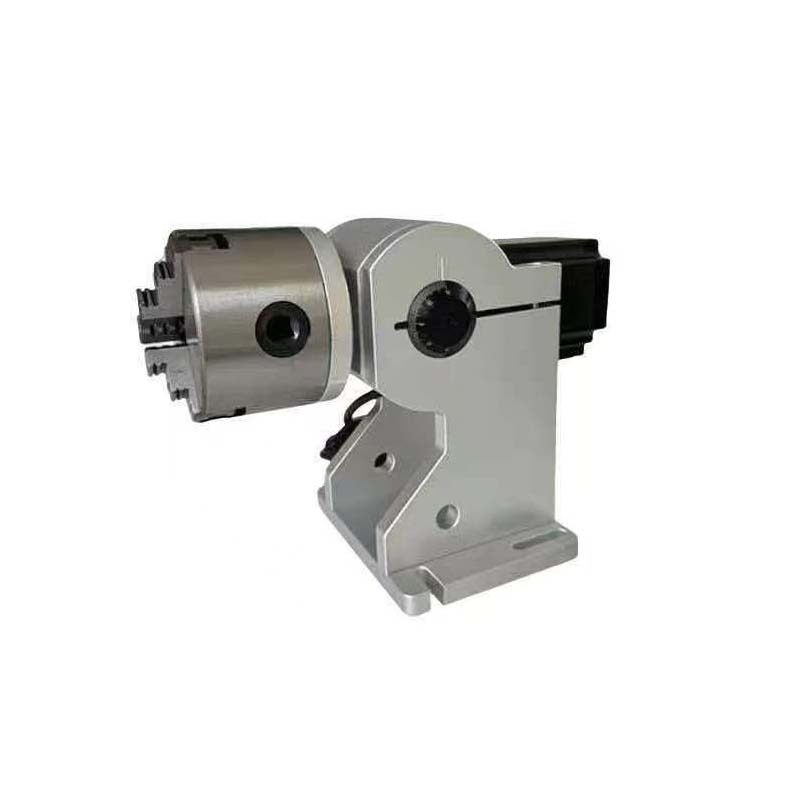
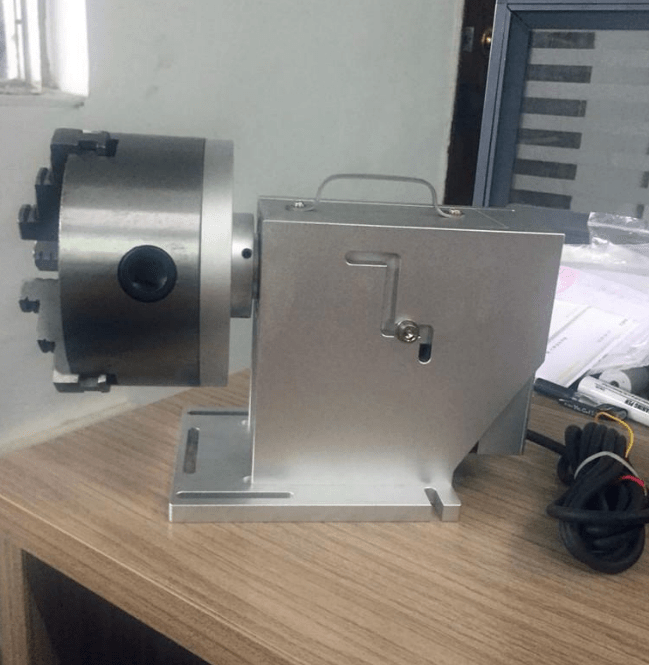
Direct Drive Rotary Axis D80/D100 (Short)
| Stepper Motor | 57*76 Snow Witte, Cable length: 2m |
| Driver Model | MC542A |
| Power Supply | 24V |
| Chuck Model | D80 / D100 |
| Transmission | Direct drive, Reduction ratio=1 |
| Center Height | 69mm |
| Angle Adjustment | Tilt up 45°, Tilt down 45° |
| Overall Dimension | 210*120*120mm |
| Max Load Capacity | ≤3kg |
The direct drive transmission with a reduction ratio of 1 eliminates backlash and gear play, so each stepper motor step translates directly to rotation. This makes the D80/D100 (Short) the preferred choice for marking small precision parts such as medical-grade rings, watch bezels, electronic components, and jewellery that require fine rotational control. The 69mm center height matches most compact CO₂ and diode laser engravers, and the full ±45° tilt range allows side-angle marking on tapered cup surfaces without re-fixturing the workpiece. With a maximum load of 3kg and dimensions of 210*120*120mm, this unit occupies minimal bed space and can be left mounted between jobs. The 2m cable length on the Snow Witte motor provides enough reach to route the wiring to the driver without extensions, and the chuck options — D80 for 80mm maximum clamping diameter or D100 for 100mm — let the operator choose the grip range that matches their typical workpiece size. For a workshop that runs a desktop laser engraver with a limited Z-axis, the 120mm overall height of this direct drive laser rotary axis keeps the rotary unit clear of the laser head at maximum travel. As a direct drive rotary axis, it offers the smoothest low-speed rotation in the series, which is essential for glass and ceramic engraving where vibration can cause fracture. This is the entry-level laser rotary axis in the series and is the most affordable option for workshops that primarily handle small personalised items such as rings, pens, and keychains. It functions as a precision rotary chuck for laser engraver systems that prioritise accuracy over raw torque capacity, making it the go-to model for fine jewellery marking.
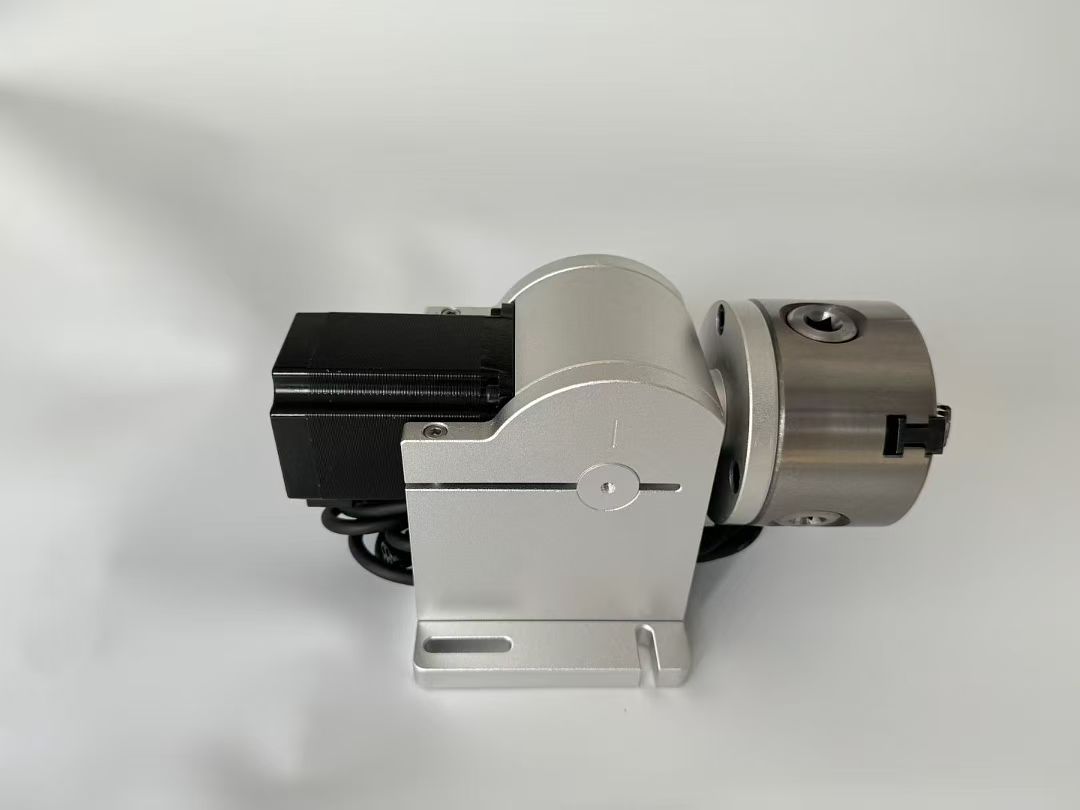
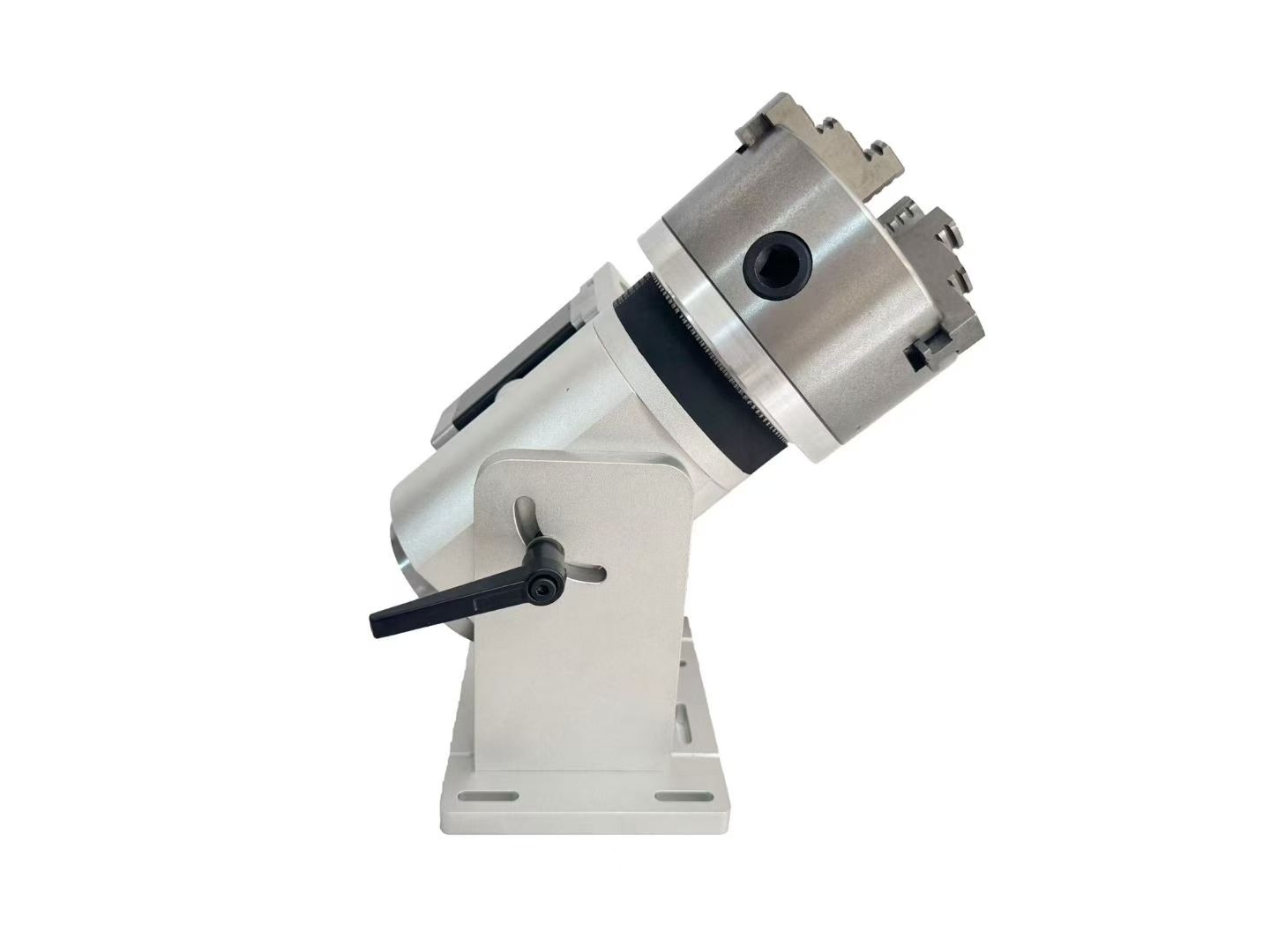
Rotary Axis SD80/SD100/SD125
| Stepper Motor | 60*88 Snow Witte |
| Driver Model | MC542A |
| Power Supply | 24V |
| Center Height | 115mm |
| Angle Adjustment | Tilt up 90°, Tilt down 45° |
| Chuck Size | D80 / D100 / D125 |
| Through Hole | 25mm(D80), 20mm(D100), 25mm(D125) |
| Transmission | Timing belt, 2.5x reduction ratio |
| Overall Dimension | 230*120*165mm |
| Mounting Hole Size | 100*50mm (M5/M6 screw) |
| Max Load Capacity | 10kg |
| Feature | High torque, through hole design, anti-shake |
The SD series uses a timing belt with a 2.5x reduction ratio, increasing torque at the chuck by a factor of 2.5 compared to direct drive. This allows the SD80/SD100/SD125 to handle heavier workpieces up to 10kg while maintaining smooth rotation. The through-hole spindle is the key differentiator — a 20mm to 25mm centre bore runs the full length of the shaft, enabling long workpieces such as engraving rods, gun barrels, or elongated aluminium profiles to pass through the axis instead of overhanging unsupported. The anti-shake chassis design and 100*50mm mounting hole pattern (M5/M6 screws) provide a rigid platform for consistent engraving depth at higher rotary speeds. The 90° upward tilt range is useful for marking the upper face of tall cylindrical objects that would otherwise collide with the laser head at a 45° limit. The 60*88 Snow Witte motor drives the timing belt with sufficient torque reserve to handle the inertia of a 10kg spinning workpiece during acceleration and deceleration, reducing banding artefacts in the engraved pattern. Three chuck sizes are available — D80, D100, and D125 — giving the operator a clamping diameter range from 0 to 125mm. The center height of 115mm suits mid-format CO₂ laser engravers with a Z-axis clearance of 150mm or more, and the 165mm overall height means the SD series fits within the working envelope of machines such as the 4060 and 6090 bed formats. This rotary axis for cylindrical engraving is the most popular configuration in the series because it handles the widest range of everyday consumer products — tumblers, bottles, mugs, and cans — with the torque needed for production-speed engraving. As a rotary chuck for laser engraver systems that need repeatable clamping, the SD series offers the best balance of throughput and precision. When a buyer needs one laser rotary axis that can serve as their daily driver for the majority of commercial engraving jobs, the SD80/SD100/SD125 is the recommended model. This is the mid-range laser rotary axis and the one that most first-time buyers should start with for a general-purpose cylindrical engraving setup.
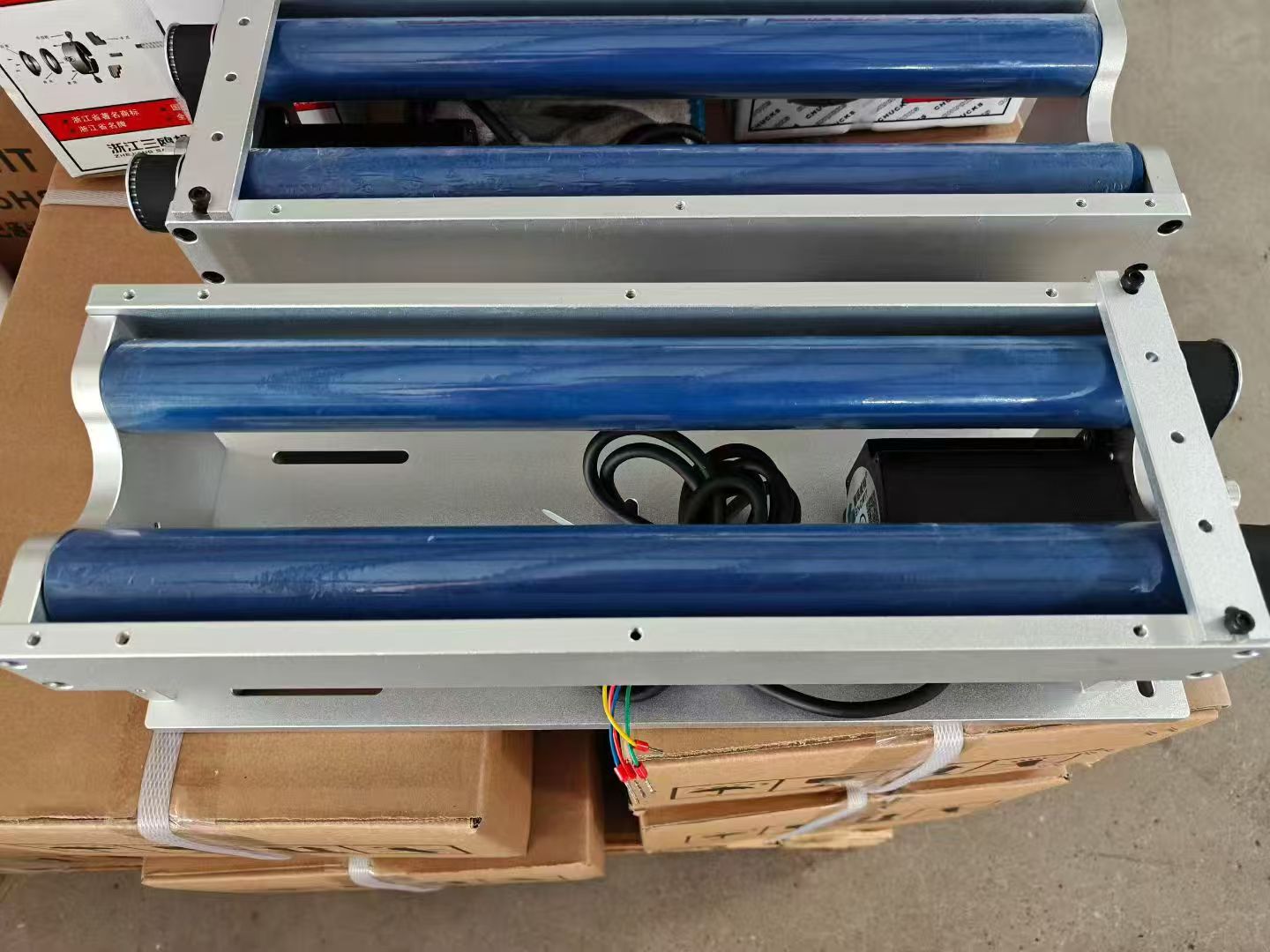
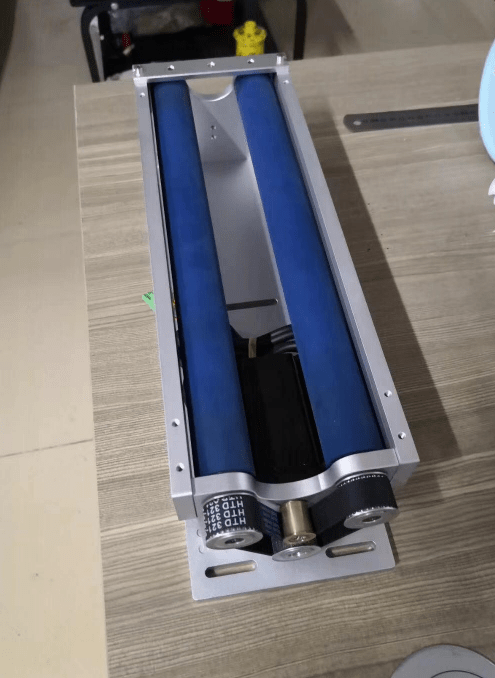
Large Roller Rotary Axis
| Stepper Motor | 60*88 Snow Witte, Cable length: 2m |
| Driver Model | MC542A |
| Power Supply | 24V |
| Shaft Length | 350mm |
| Shaft Spacing | 40mm |
| Overall Dimension | 400*125*110mm |
| Applicable Workpiece Diameter | 50–400mm |
| Max Load Capacity | ≤30kg |
| Feature | Fast clamping, wide applicable range |
| Note | Not fit for full 360° seamless marking & tapered parts |
The large roller axis uses a dual-roller cradle design that supports the workpiece along two parallel contact shafts rather than gripping it with a chuck. This makes it the right choice for large-diameter items — drinkware, sports bottles, vases, pipe sections, and cylindrical containers between 50mm and 400mm in diameter — that cannot be held by a three-jaw chuck. The 350mm shaft length accommodates long workpieces, and the 400mm overall footprint means it fits within the working area of most medium-format CO₂ laser engravers. Load capacity reaches 30kg, covering heavy glass and stainless steel items. The fast-clamping mechanism uses a sliding adjustment: the operator moves the rear roller to match the workpiece diameter and tightens without tools. The 110mm overall height is the lowest among the three models, which helps clear the laser head on machines with limited Z-axis travel. The 60*88 Snow Witte motor drives one roller shaft, and the second roller spins freely, so the workpiece rotates at a consistent surface speed determined by the motor’s RPM and the workpiece diameter. The applicable workpiece diameter range of 50–400mm covers the majority of consumer drinkware — from slim cans to large beer growlers — plus industrial pipe sections up to 40cm across. Note that the roller design has two limitations: it does not support full 360° seamless marking because the workpiece contacts the rollers at the engraving zone, creating a gap where the pattern restarts; and tapered or conical parts such as flared wine glasses or tapered cups will not sit evenly on the parallel rollers. For these applications, the SD series with a chuck and tilt adjustment is the correct choice. This roller rotary attachment is the heaviest-capacity option in the series and is designed for dedicated high-volume bottle marking lines or workshops that regularly process large-format cylindrical items. As a roller rotary attachment, it eliminates the need to manually align each workpiece in a chuck — the operator simply places the workpiece on the rollers and secures it with the sliding clamp, reducing setup time per piece. This is the largest laser rotary axis in the series and requires a compatible laser engraver with a bed size of at least 400mm in one axis. It is the ideal roller rotary attachment for workshops that receive frequent orders for large sports bottles, water jugs, and industrial pipe marking.
Product Features
The three models share a common electrical and control platform that simplifies deployment across a workshop. Every unit runs on a 24V DC power supply and is driven by the MC542A stepper driver, a micro-step controller that supports 2-phase stepper motors with switch-selectable current and resolution. All three use Snow Witte stepper motors — a 57*76 frame on the direct drive model and a 60*88 frame on the SD and roller models — with consistent wiring pinouts, so one controller configuration serves the entire series. The angle adjustment mechanism is present on every laser rotary axis, with the direct drive and roller units providing ±45° tilt and the SD series offering 90° upward tilt. Each axis ships with a standard mounting base that bolts to the laser engraver bed using the machine’s T-slot or pre-drilled holes, and the 24V power supply is identical across all three, reducing spare-part inventory for multi-machine operations. The direct-drive interface between the MC542A driver and the motor is the same regardless of which model is connected, so a workshop can swap units on the same driver by plugging in the motor cable and adjusting the workpiece height in the laser software — no driver parameter changes are needed. All three models also use the same 4-pin motor connector wiring standard, so replacement cables and extension cords are interchangeable across the series. The mounting plates on all three axes use metric hardware that is compatible with standard 2020 and 2040 aluminium extrusion T-slot profiles, the most common bed material on Chinese-manufactured laser engravers. These shared design choices mean that any laser rotary axis in the series can be installed, removed, and swapped with another model in under five minutes, making it practical for a single laser engraver to serve multiple rotary axis configurations throughout a production day.
Business Value
Adding a laser rotary axis to a laser engraver expands the machine’s printable surface from flat sheets to the full circumference of cylindrical objects, multiplying the addressable product range without purchasing a second laser source. A single rotary axis opens the tumbler, bottle, and pen customisation market, which commands higher per-piece margins than flat acrylic or wood signage. The three-model series lets a workshop start with the direct drive unit for small-batch personalised items and scale to the SD or roller axis as order volume and workpiece sizes grow, without changing the controller or power supply infrastructure. The shared MC542A driver and 24V platform mean an operator trained on one model can run all three, and spare parts — power supplies, cables, driver modules — are interchangeable across the line. For a laser engraving business sourcing consumables and accessories, stocking a single driver family instead of three incompatible systems reduces inventory complexity and supplier management overhead. The capital investment in the first laser rotary axis is protected because the driver and power supply are reused when adding a second axis, and the learning curve for the operator is effectively zero for the second model. Bulk buyers who stock all three models can offer their end customers a complete cylindrical engraving solution — from a 3kg precision rotary for small-item personalisation through to a 30kg roller axis for industrial bottle marking — under one supplier relationship rather than sourcing from three different rotary axis vendors with incompatible interfaces. The 24V operating voltage means the power supply can be sourced from any standard industrial supplier, avoiding proprietary replacements when the original unit reaches end of life. The same driver and power supply serve all three models, making the second and third axis purchases substantially cheaper than the first.
Applications
The direct drive D80/D100 (Short) is best suited for small-batch precision marking on jewellery, rings, watch components, medical instruments, and electronics housings where rotational accuracy matters more than torque. The 3kg limit and compact footprint make it a permanent fixture on a dedicated fine-marking laser station. The SD80/SD100/SD125 handles the mid-range workload that makes up the bulk of a rotary engraving operation — stainless steel tumblers, beer mugs, wine glasses, cosmetic bottles, and promotional pens. The through-hole spindle is particularly useful for long items such as golf club shafts, tool handles, and chisels that extend beyond the axis body. The large roller axis is the solution for jumbo-sized workpieces — large sports water bottles, growlers, vases, candle holders, pipe segments, and industrial cylindrical parts up to 400mm in diameter. A typical workshop might run the SD series for daily production and switch to the roller axis for large-batch bottle orders or seasonal promotional runs. The 90° tilt on the SD series is used when engraving the shoulder area of wine bottles or the curved top of a tapered cup, where the laser head would otherwise hit the workpiece at the standard 45° tilt. For glassware etching, the smooth rotation of the direct drive laser rotary axis at low RPM minimises vibration that can cause cracking in thin-walled glass, while the roller axis with its wide contact surface distributes the weight of heavy glass bottles evenly across the two rollers. The through-hole on the SD80 and SD125 is particularly valuable for service bureaus that engrave serial numbers or barcodes on elongated metal parts such as torque wrenches or surgical instruments — the workpiece passes through the spindle and the engraving is applied in a single pass rather than requiring multiple indexing operations. Using a rotary axis for cylindrical engraving, a workshop can expand into wedding gift personalisation, corporate promotional merchandise, and industrial part marking without adding a second laser engraver. The SD series as a rotary chuck for laser engraver applications offers the fastest job changeover because the three-jaw chuck centres the workpiece automatically, eliminating the manual centring required on roller-type systems. For a workshop that processes a diverse mix of workpiece sizes every day, having access to all three laser rotary axis models means they never turn away an order because the workpiece is too large for the chuck or too small for the rollers. The series enables a workshop to quote on cylindrical engraving jobs of any scale, from single-piece personalised gifts to bulk production runs of promotional merchandise.
Why Choose This Laser Rotary Axis Series
The series offers a complete range of rotary engraving solutions on a single electrical platform, so adding a second axis to an existing setup requires no new power supply or driver configuration. The use of Snow Witte stepper motors and MC542A drivers across all three models means the tuning and micro-step settings learned on one unit transfer directly to the others. The mounting hole patterns and centre heights are designed around standard laser engraver bed dimensions, and the tilt adjustment range on each model covers the common marking angles needed for conical and tapered cups. For a laser engraving workshop that processes cylindrical products of varying sizes and materials, this series provides a coherent upgrade path from small-batch precision work through to heavy industrial roller marking. The three models share the same motor wiring, power supply, and driver interface, so a workshop that has already deployed one unit can add a second in under an hour — mount the axis, plug in the motor cable, and set the workpiece height in the engraving software. The D80/D100, SD80/SD100/SD125, and large roller models are designed to be complementary rather than overlapping, so a workshop that stocks all three can quote on any cylindrical engraving job that comes through the door without turning away work that exceeds the capacity of a single-axis setup. The 24V operating voltage is also compatible with the majority of aftermarket laser engraver controller boards, including Ruida, Cohesion3D, and Smoothieboard-based systems, making integration straightforward for both new builds and retrofits. Each unit ships with a pre-configured MC542A driver set to the correct micro-step resolution for its motor, so first-time setup involves connecting three wires — power, motor signal, and ground — and the axis is ready to accept engraving jobs.
FAQ
Q1: What is the difference between the direct drive and the SD belt-driven rotary axis?
A: The direct drive D80/D100 (Short) has a 1:1 reduction ratio — one stepper step equals one degree of rotation, giving zero backlash for small precision parts under 3kg. The SD series uses a timing belt with a 2.5x reduction ratio, which multiplies torque by 2.5 and adds a through-hole spindle for long workpieces, supporting loads up to 10kg.
Q2: Which model should I choose for engraving stainless steel tumblers?
A: The SD80/SD100/SD125 series is the standard choice for stainless steel tumblers. The 10kg capacity covers even heavy double-wall tumblers, the through-hole spindle accommodates extra-long flasks, and the anti-shake design maintains consistent engraving depth at the rotational speeds required for 360° marking.
Q3: Can the large roller axis do full 360° seamless marking?
A: No. The roller axis supports the workpiece on two contact shafts, so the area touching the rollers cannot be engraved without re-positioning. Seamless full-circle marking requires a chuck-based laser rotary axis such as the SD series, where the workpiece is held at one end and the entire circumference is exposed.
Q4: What power supply does the rotary axis need?
A: All three models use a 24V DC power supply. The MC542A stepper driver accepts 24V input and the Snow Witte motors are rated for 24V operation. The same power supply model works across the entire series.
Q5: How do I mount the rotary axis to my laser engraver?
A: The direct drive and SD series bolt to the laser bed using M5 or M6 screws through the base plate. The SD series has a specified mounting hole layout of 100*50mm. The large roller axis sits on its own base and is secured with screws through the 400*125mm footprint. All three mount to standard T-slot aluminium beds.
Q6: What is the maximum workpiece length for the through-hole on the SD series?
A: The through-hole diameter is 25mm on the D80 and D125 chucks, and 20mm on the D100 chuck. The workpiece length is limited only by the laser engraver’s working area — the through hole allows the item to pass through the axis so it does not overhang unsupported.
Q7: Can the direct drive D80/D100 handle glass or ceramic items?
A: Yes, as long as the weight is under 3kg. The direct drive’s smooth rotation at low speed is well suited for marking glassware and ceramic mugs, where vibration or jerk can cause cracking. The full ±45° tilt helps position the laser head relative to the curved surface.
Q8: What is the difference between the D80 and D100 chuck options?
A: The D80 chuck has a maximum clamping diameter of 80mm, and the D100 clamps up to 100mm. Both are available on the direct drive and SD series. The SD series also adds a D125 chuck with a 125mm clamping diameter for the SD125 model.
Q9: What software settings need to change when switching between the three models?
A: The primary change is the steps-per-rotation value in the laser software, which depends on the motor’s micro-step setting and the reduction ratio. For the direct drive (1:1 ratio), the value is determined by the motor’s native step angle and the driver’s micro-step setting. For the SD series (2.5:1), the value is multiplied by 2.5. For the roller axis, the effective circumference of the workpiece must be entered so the software calculates the correct rotation speed for the given diameter. The MC542A driver’s DIP switch settings for current and micro-step resolution remain the same across all three models.
Q10: Does the laser rotary axis series work with a diode laser engraver?
A: Yes. All three models operate on 24V DC and use the same MC542A stepper driver, which is compatible with the controller boards used in most diode laser engravers. The direct drive D80/D100 (Short) with its 69mm center height is a common pairing with compact diode machines. The SD series also works with diode lasers that have sufficient Z-axis clearance for the 115mm center height.